AMRs in the Distribution Center: The Practical Guide to Transforming Your Warehouse with Autonomous Mobile Robots
In Mexico, running a distribution center today means constant pressure: deliver faster, with fewer errors and with controlled costs. The growth of e-commerce, the expectation of ever-faster deliveries and the push of nearshoring have raised the bar for logistics operations. It is no longer enough to “get the work out”; now it has to be done with precision, visibility and continuity.
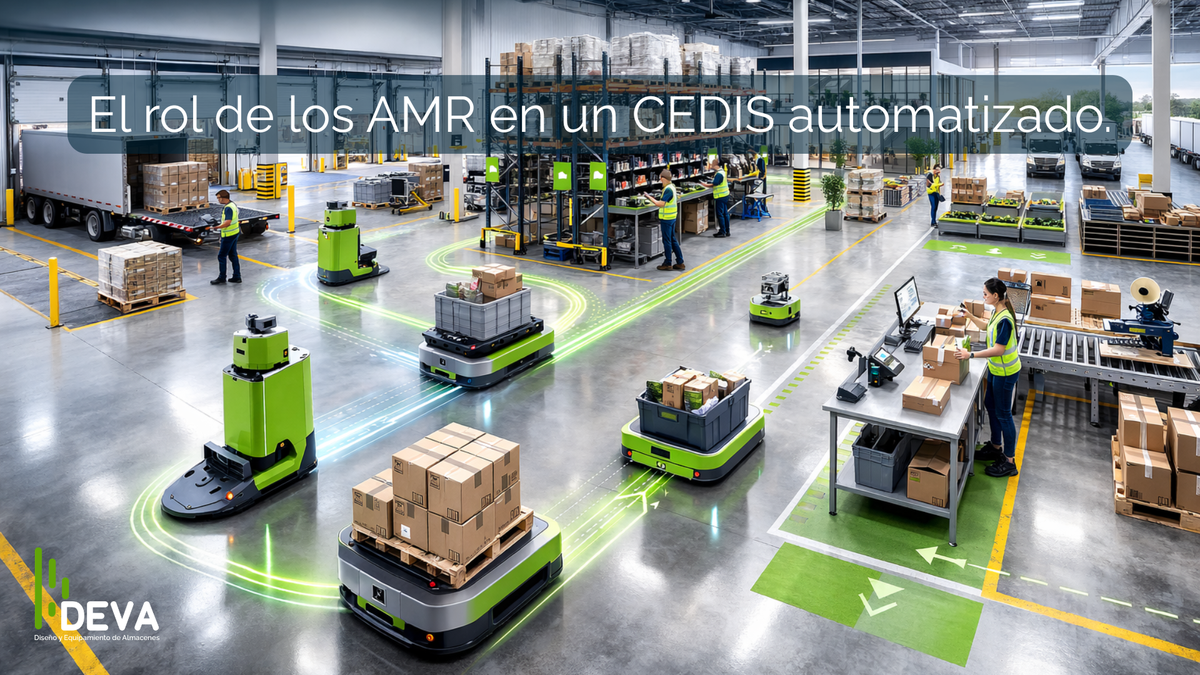
In that context, many companies keep facing the same problem on the warehouse floor: valuable staff tied up in repetitive transfers, long travel distances, idle time between processes and bottlenecks that appear just when demand rises. In other words, the challenge is not always working harder, but moving the flow better.
This is where AMRs (Autonomous Mobile Robots) come in. More than a machine, an AMR is a flexible, intelligent solution for automating internal moves and connecting processes within the distribution center. Its value lies not only in “transporting things”, but in helping receiving, picking, packing and dispatch work as a synchronized system.
What is an AMR and how is it different?
An AMR is a robot that moves autonomously within the warehouse to transport cases, containers, racks or pallets (depending on the application). Unlike more rigid technologies, an AMR does not need wires, rails or tape stuck to the floor to know where to go.
In simple terms, it “sees” its surroundings with sensors and cameras, creates a digital map of the warehouse and navigates based on that map. If an obstacle appears (a forklift, a misplaced pallet or a person crossing) the robot can slow down, stop or take an alternative route safely.
That ability to react in real time is key. In a real warehouse, conditions change all the time: there are peaks in the operation, congested zones, occupied aisles and unexpected movements. An AMR is designed to coexist with that reality and collaborate with workers, not to force the warehouse to operate like a fixed line.
In addition, it can be integrated with systems such as the WMS (Warehouse Management System), the software that organizes inventories, tasks and movements. In practical words: the WMS “tells it” what needs to be moved and the AMR carries out that transfer automatically, with traceability.
The AMR in action: Transforming the 4 key areas of the warehouse
The great advantage of AMRs is that their impact is not limited to one point in the process. Properly implemented, they become a layer of intelligent mobility that connects several areas of the distribution center. Let’s see how.
1) Receiving (Inbound): Speeding up the flow from the dock
A common scene in receiving: a truck arrives, goods are unloaded, documentation is validated, product is checked and then someone has to move cases or pallets to inspection, quarantine or storage zones. In high-volume operations, those transfers consume time and create build-up at the docks.
An AMR can take over that repetitive task. Once the goods are unloaded at a defined point, the robot transports the material to the quality control zone or directly to the temporary storage area. Meanwhile, staff focus on higher-value activities, such as validation, inspection and recording.
The result? Less congestion in receiving, better use of dock space and a more agile inbound flow. In peak seasons, this can make the difference between an orderly operation and a receiving area that “jams up” from the very first hour.
2) Picking (Storage and Preparation): From walking to the order to bringing the order to the worker
In many distribution centers, picking is still one of the most expensive stages because of the time spent walking. A worker can cover kilometers per shift looking for products in different locations. That time doesn’t always add value; often it is just travel.
This is where the goods-to-person model comes in (“the goods come to the person”). Instead of the worker traveling through the warehouse, the AMR can bring movable shelving units, containers or totes to a picking station. That way, the worker stays in an ergonomic position and concentrates on selecting and confirming product.
In practice, this reduces travel, speeds up the picking pace and improves accuracy, because the process becomes more guided and orderly. It also helps standardize the work, which is very useful when there is staff turnover or temporary hiring during demand peaks.
For an operations manager, the message is clear: the AMR doesn’t replace the team’s judgment; it eliminates unnecessary travel so the team can perform better where it really adds value.
3) Packing (Pack-Out): A smart conveyor between picking, packing and sortation
Another frequent situation: orders are prepared in picking, but then pile up waiting to be moved to packing. Or, once packed, they sit idle before moving on to sortation by parcel carrier, route or customer. That “time between processes” is often not measured well, but it does affect total throughput.
AMRs can work as a smart, flexible conveyor. They pick up prepared orders from picking stations and take them to the packing area. Then, once the package is closed and labeled, another AMR can move it to the corresponding sortation zone.
The difference from a fixed conveyor is flexibility. If the stations change tomorrow, a product line grows or the layout is reorganized, the AMR system can adapt with less physical intervention. This is especially valuable in operations that evolve quickly or are still fine-tuning their optimal design.
In practical terms, it translates into less accumulation, better synchronization between areas and greater visibility of the flow.
4) Dispatch (Outbound): Delivering to the dock door at the right moment
In dispatch, operational punctuality is everything. Orders must reach the correct outbound door, in the right sequence and just in time to load the truck. When this coordination fails, delays, unnecessary maneuvers and pressure on the team follow.
AMRs can take charge of moving consolidated pallets or containers from packing or staging to the assigned outbound door. This makes it possible to organize loading windows better, reduce forklift travel in congested zones and keep outbound flow more orderly.
Think of a shift close with multiple routes: instead of depending on phone calls, rush jobs and improvised moves, the AMR executes scheduled, prioritized tasks. The flow becomes more predictable. And in logistics, predictability is a competitive advantage.
The path to efficiency
The real transformation does not come from having “robots” in the warehouse, but from integrating intelligent mobility into the operational flow. When AMRs are implemented correctly in receiving, picking, packing and dispatch, the distribution center gains continuity: fewer manual transfers, fewer bottlenecks, better accuracy and a more scalable operation.
The most important thing is to understand that automation with AMRs is not a futuristic fantasy reserved for global giants. It is a practical, modular and attainable tool for mid-sized and large companies that need to improve productivity without losing flexibility.
At DEVA, we understand that every warehouse has different challenges: layout, processes, volume, type of product, demand peaks and existing systems. That is why our approach is not to sell an isolated robot, but to design an end-to-end solution that truly works in your operation. From the initial diagnosis to software integration and commissioning, we act as the architect of your warehouse of the future.
If you are evaluating how to improve the efficiency of your distribution center, this is the best moment to start with a consultation. At DEVA we can analyze your case, identify where an AMR has the greatest impact and design an automation roadmap tailored to you. Because transforming your warehouse doesn’t start with a purchase; it starts with a strategy.
Ready to optimize your warehouse?
Talk with a DEVA expert and get a free personalized warehouse assessment.