Artificial Intelligence in Intralogistics: From "Passive Steel" to Cognitive Automation
In today's supply chain context in Mexico, driven by nearshoring and unprecedented omnichannel demand, conventional automation of distribution centers has reached a natural limit. For years, the industry focused on deploying physical infrastructure (conveyors, pallet flow racking and sortation systems) as the definitive solution. However, in the era of volatility, "steel" alone is no longer enough. The real competitive differentiator today does not lie in the speed of the hardware but in the intelligence that orchestrates the movement.
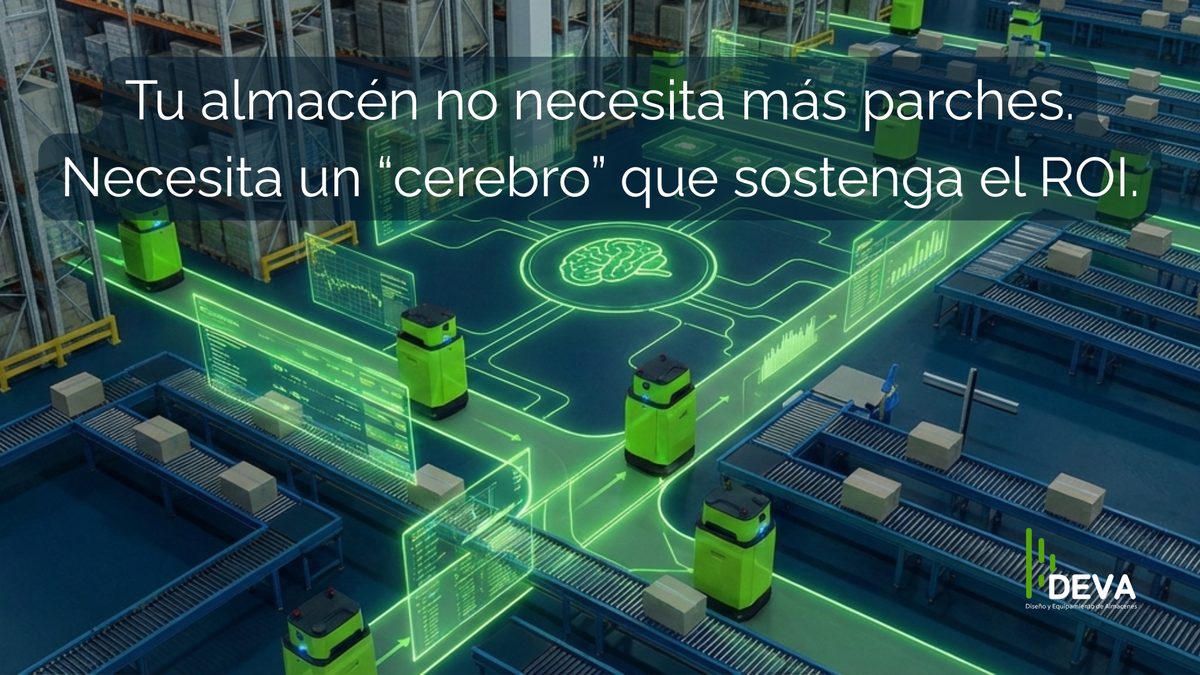
As expert intralogistics integrators, at DEVA we understand that Artificial Intelligence (AI) should not be seen as an isolated product or as software bought “off the shelf”. For a world-class operation, AI is the tool that makes it possible to move from reactive automation to predictive orchestration. The value of a systems integrator lies precisely in the ability to take these new technologies and weave them into the company’s operational, financial and technological fabric, turning scattered data into real-time flow decisions.
For Operations and Supply Chain Directors, integrating AI into automation solves the chronic problem of poor visibility and saturation. While a traditional system executes orders in a linear way, a solution integrated with deep learning algorithms enables dynamic slotting management and load balancing that anticipates bottlenecks. This translates into operational fluidity that protects OTIF and maximizes installed capacity without the need for massive investments in additional physical infrastructure. It is not just about moving boxes faster, but about moving them intelligently to reduce the cost per order.
On the floor, where the Warehouse Manager and the Continuous Improvement Lead face the challenge of daily productivity and the skilled labor shortage, AI acts as a facilitator of methods. Through machine vision and route optimization, the technology guides workers or robotic systems, eliminating idle time and picking errors. As integrators, at DEVA we bring to the table solutions that standardize work and eliminate “ghost locations”, so that operational discipline does not depend on individual heroics but on a system designed for excellence.
From the IT and Finance perspective, the role of an expert integrator is to mitigate risk and secure the return on investment (ROI). AI could act as a bridge that unifies the WMS, the ERP and the control layer (WCS), ensuring a robust, scalable data architecture. By modeling scenarios and risks with precision, it could allow the CFO to see a solid business case where operational savings and cash flow efficiency justify the CAPEX.
In conclusion, the future of intralogistics does not belong to those with the most machines, but to those with the smartest and best-integrated machines. True digital transformation in intralogistics is not about buying technology; it is about enabling a strategic organizational capability. AI is the partner that aligns everyone: from the worker on the floor, who gains in ergonomics and clarity, to executive management, which gains in margin, customer service and competitive resilience.
The question for companies in Mexico today is not whether the technology is capable, but whether its integration is the right one. At DEVA, we believe the success of a smart distribution center starts with an honest diagnosis of its current bottlenecks. We are not software developers looking for a problem; we are consultants and engineers who understand the real challenges, and we design solutions that adapt to the complexity and needs of your operation.
Want to discover the optimization potential of your distribution center?
Schedule an assessment with our specialists.
Ready to optimize your warehouse?
Talk with a DEVA expert and get a free personalized warehouse assessment.