Can your company survive without automating its warehouse in the new industrial era?
Mexico is going through a historic moment. Nearshoring has put the country in the sights of global companies looking to relocate their production close to the United States, and our territory has become a natural magnet for that investment. At the same time, e-commerce keeps growing at a rapid pace, completely changing the rules of the game for delivery times, order accuracy and logistics costs.
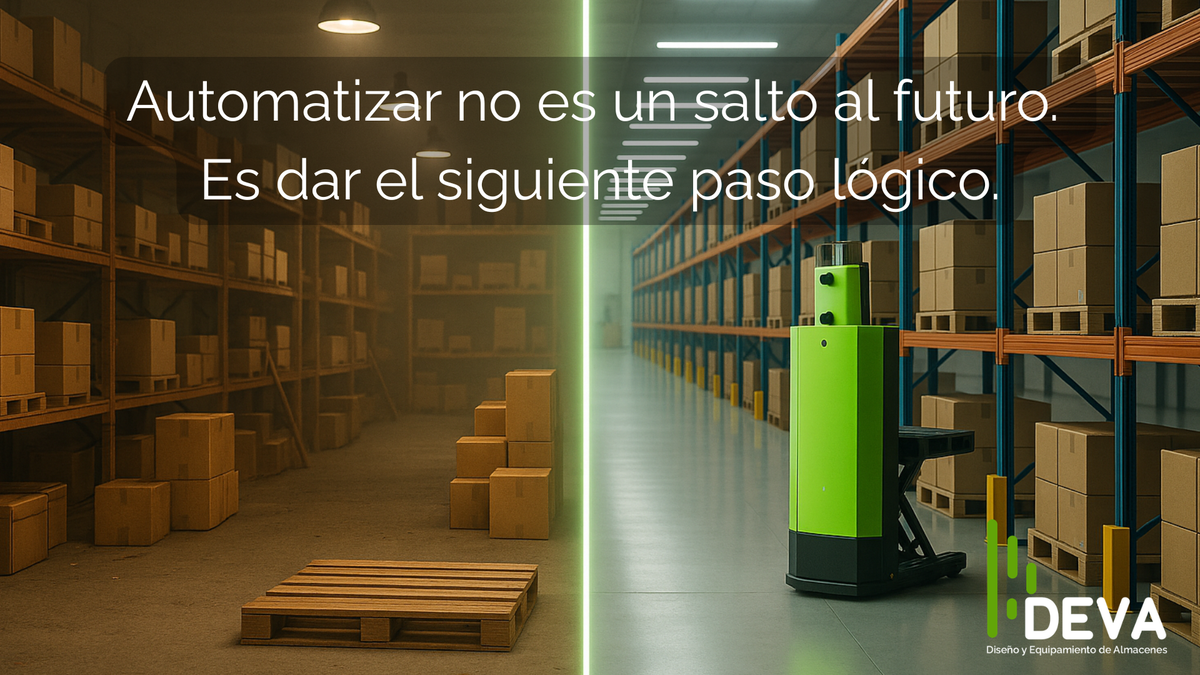
But here comes the uncomfortable part: many warehouses in Mexico still operate the way they did 20 or 30 years ago. Manual processes, Excel sheets that go out of date the moment someone opens them, exhausted crews running from one end to the other, supervisors putting out fires. And although those methods were enough in their day, today they are a silent brake: they create hidden costs, constant errors and lost opportunities against competitors who are already a step ahead.
The moment won’t wait
The nearshoring wave will not wait for companies to catch up. International customers demand reliability and full visibility, along with strict compliance with lead times and agreements. A late order or a wrong inventory count is no longer a minor error: it can mean losing a contract for good.
And when it comes to e-commerce, the challenge is even greater. Consumers don’t forgive: they want fast deliveries, without errors and at a good price. Meeting those expectations with a manual warehouse, where overtime and errors are an everyday occurrence, is simply unsustainable. That is why automation is no longer a futuristic luxury but a strategic necessity.
The real impact of automation
The benefits of taking this step show up at every level.
For executive management and finance, automation cuts invisible expenses off at the root: overtime, shrinkage, returns and penalties for missed commitments. What seemed “inevitable” starts turning into measurable savings and stronger margins.
For operations, it means order and control: processes that flow, real-time inventory visibility, teams that can finally hit their daily targets and satisfied customers because SLAs are met.
For supervisors and plant managers, it means breathing room: less pressure, fewer human errors, fewer injuries from repetitive tasks, and the ability to handle demand peaks without relying on a disproportionate increase in headcount.
In short, automating doesn’t just make the warehouse more efficient: it makes it more humane and more profitable.
Tailored solutions, not science-fiction robots
There is a belief that automating means investing millions in futuristic systems. The reality is different: automation adapts to the scale and needs of each company.
- First step: define and optimize processes through automation with the help of a WMS. Tools that give the process traceability and help reduce errors, improve material flow and give you immediate control.
- Second step: technologies such as AMRs (autonomous mobile robots), pick-to-light/put-to-light or other sortation systems that multiply order picking speed and reduce dependence on manual labor.
- Advanced step: Combining different technologies for full automation, for example solutions such as AS/RS or stacker cranes, which make use of every cubic meter and let you scale the operation to an entirely new level.
The results are clear: up to 99.9% fewer inventory errors, picking 3 times faster, 30-50% space optimization and operations less dependent on labor-intensive work, which is harder and harder to retain these days.
It’s not just efficiency, it’s resilience
Automation is not only about being faster or more accurate. It is about being resilient in an increasingly competitive and uncertain environment. About building operations that can grow at the pace of demand, withstand the ups and downs of the market and guarantee customer satisfaction without compromising profitability.
The companies that decide to take this step will be the ones setting the pace in the new industrial era. Those that don’t will be increasingly exposed to losing customers, contracts and competitiveness.
The time is now
Investing in automation is not an expense, it is a strategic decision with a return on investment within the time frames the industry demands today. It opens the door to better margins, greater growth capacity and safer, more motivated teams.
At DEVA, we understand that every warehouse is different, and whatever the size of your company, we can work out the perfect solution for you. That is why we design customized solutions ranging from WMS software in Mexico to high-density automated storage systems, and our team is backed by over 30 years of experience transforming operations across different sectors.
Request your assessment with DEVA and discover how your warehouse can become the competitive advantage your company needs.
Nearshoring and e-commerce are already changing the landscape. The question is simple: are you ready to ride the wave, or will you let it pass you by?
Ready to optimize your warehouse?
Talk with a DEVA expert and get a free personalized warehouse assessment.