
The Hidden Cost Eroding Your Distribution Center's Profitability: The Electricity Bill Is Now a Competitiveness Problem
Imagine that every time your distribution center processes an order, someone is setting fire to a 20-peso bill and letting it burn away. Nobody sees it. It is not on the income statement as a separate line. But it is there, diluting your operating margin month after month.
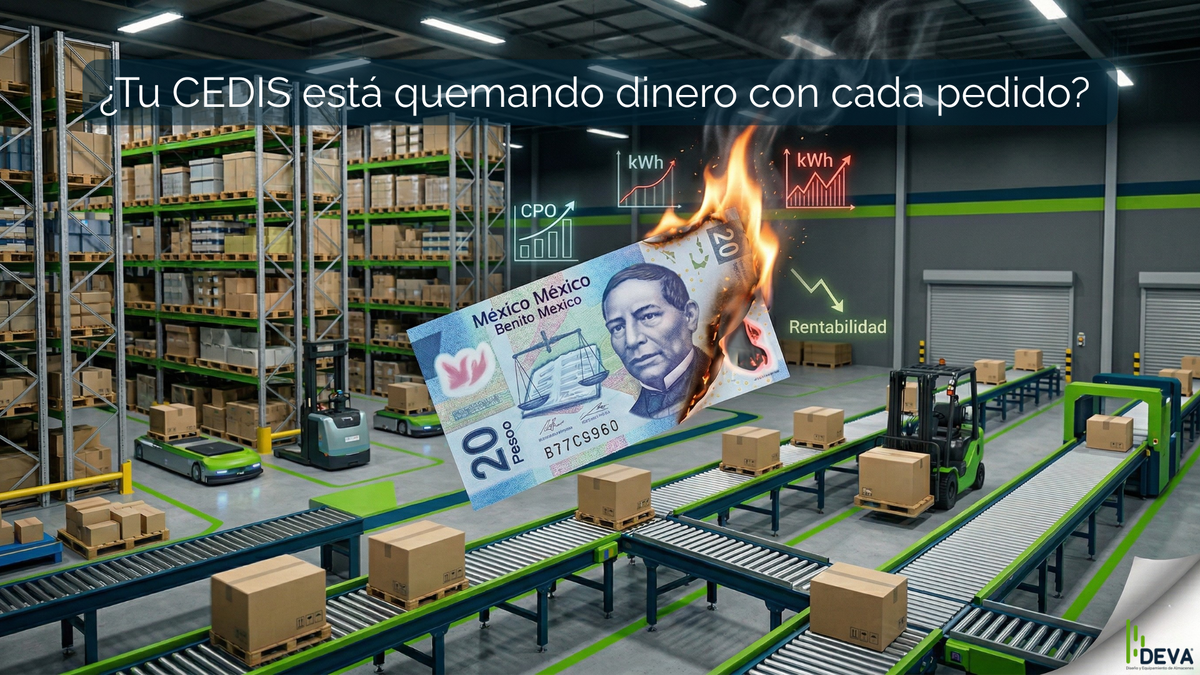
That someone is your operation’s unmanaged energy consumption.
For decades, the debate in logistics revolved around two major cost levers: payroll and physical space. Today, in 2026, electricity has fully entered the picture as the third critical factor in Cost per Order (CPO), and many operations directors in Mexico still don’t have it on their dashboard.
In this article we analyze why energy efficiency in distribution centers has stopped being an environmental issue and become a direct lever of profitability and competitiveness, and how the smart design of your operation can make the difference.
1. The Perfect Storm: Regulation + Prices + Inefficient Operations
Mexico is at a turning point in energy matters. The combination of three factors is creating unprecedented pressure on the operating costs of any distribution center that has not modernized its infrastructure:
1.1 New NOM Standards: Compliance That Costs (If You’re Not Prepared)
Updates to the Official Mexican Standards on energy efficiency are imposing more demanding requirements on industrial and commercial facilities. Specialized media such as Mexico Business News have documented how the transition to a stricter regulatory framework directly affects manufacturing, storage and distribution operations.
The key point: regulatory compliance is no longer optional. Companies that do not adapt their facilities will face not only fines but a competitive disadvantage against operators that have already optimized their consumption.
1.2 Rate Volatility and Demand Peaks
Industrial rates from the CFE (the Federal Electricity Commission), especially HM and HS, severely penalize demand peaks (kW). This means you pay not only for how much energy you consume (kWh), but for when you consume it and the maximum power you demand.
A distribution center that starts up all its sorter lines, electric forklifts and HVAC systems simultaneously during its busiest shift may be paying up to 30% or 40% more in demand charges than it would if it staggered those start-ups intelligently.
1.3 The Real Problem: Operations Designed Without Energy Awareness
Most distribution centers in Mexico were designed under a logic of “more square meters, more racking, more equipment”. Energy was a secondary variable. The result: facilities with oversized lighting, motors without variable frequency drives, refrigeration systems running at 100% when they could operate at 60%, and layouts that generate unnecessary travel that consumes time and electricity.
📊 Key fact to reflect on:
According to industry estimates, between 20% and 35% of energy consumption in logistics facilities goes to lighting. An industrial LED retrofit project with occupancy sensors can generate savings of up to 60% in that item alone, with payback periods of 18 to 36 months.
2. The Cost per Order Nobody Is Calculating
Cost per Order (CPO) is one of the most relevant KPIs in logistics operations. Traditionally it includes: direct labor, packaging, occupied space and technology. But there is one component that rarely appears broken out in reports:
- Energy consumed per product movement (kWh/unit moved)
- Electrical demand cost prorated per order processed
- Consumption tied to maintaining conditions (HVAC, cold rooms)
- Lighting system energy in picking and staging zones
- Consumption of material handling equipment (electric forklifts, conveyors, sorters)
If you add up all these components for a mid-sized operation (between 500 and 2,000 orders a day), the result can represent between 8% and 15% of total CPO. In a high-volume operation, that means millions of pesos a year that don’t appear on any dashboard as “loss due to energy inefficiency”.
The problem is not that energy is expensive. The problem is that nobody is measuring it correctly as a supply chain optimization lever.
3. The Energy-Aware Approach: Designing Operations That Guard Every kWh
The solution is not to cut back operations. It is to redesign them from an operational efficiency perspective that builds in energy consumption as a design variable from day zero.
We call this the energy-aware approach: a distribution center design philosophy in which every technology decision, every equipment selection and every layout configuration is evaluated not only by its functionality and acquisition cost, but by its impact on long-term energy consumption.
3.1 Industrial LED Lighting: The Most Underrated Quick Win
Replacing conventional fixtures with high-efficiency industrial LED systems, combined with occupancy sensors and zone control systems, is consistently one of the projects with the best cost-benefit ratio in any distribution center.
It is not just about changing light bulbs. It is about designing a lighting system that adapts to the real activity in each zone: full lighting in active aisles, automatic dimming in zones without movement, and smart control by schedule and occupancy.
3.2 Motors and Variable Frequency Drives: The Money Hidden in Load Curves
Electric motors account for between 40% and 60% of total consumption in industrial facilities. In a distribution center, this includes the motors of conveyors, sortation systems, automatic doors, ventilation and auxiliary equipment.
Installing variable frequency drives (VFDs) on the right motors can reduce consumption by between 20% and 50% in variable-load applications. The logic is simple: a motor running at 80% of its rated speed does not consume 80% of the energy, but approximately 51% (the relationship is cubic). That is real money.
3.3 Smart Demand Management: Stagger So You Don’t Overpay
One of the most effective and least costly strategies to implement is staggered start-up management. By scheduling the start of the highest-consumption equipment sequentially (rather than simultaneously), you drastically reduce the demand peak recorded by the CFE, which is what determines the fixed monthly charge on industrial rates.
This practice, combined with real-time monitoring of consumption by zone, lets operations managers make informed decisions during the shift: can I turn on the additional refrigeration system now without triggering the demand peak?
3.4 Warehouse Automation: The Double Benefit
Warehouse automation (from vertical transport systems to automated picking solutions) does more than reduce dependence on labor and increase processing speed. It also has a direct impact on energy consumption when efficient technologies are selected.
A properly designed automated storage system can process the same volume of units with 30% to 45% lower consumption than an equivalent manual operation, thanks to optimized travel, the elimination of idle time and precision in the use of equipment.
4. Sustainability That Shows Up on the Income Statement
The sustainability agenda in logistics and the supply chain is no longer just a matter of corporate reputation or ESG compliance. In today’s operating context, energy sustainability has a direct, quantifiable impact on profitability:
- CPO reduction by lowering the energy component
- Greater predictability in fixed costs by reducing exposure to rate peaks
- The ability to demonstrate energy efficiency to corporate customers with sustainable procurement policies
- Access to green financing lines with preferential rates for efficiency projects
- Carbon footprint reduction as a differentiator in logistics tenders
The digital transformation of a distribution center is not complete without energy measurement instruments. A WMS (Warehouse Management System) without integration with electricity consumption data is only telling half the story.
Checklist: Is Your Distribution Center Wasting Energy Right Now?
Use this quick diagnostic checklist to identify the main energy leaks in your operation. If you have more than 4 “yes” answers, your distribution center has an efficiency problem that is already hurting your competitiveness:
- Is your lighting system more than 8 years old, without occupancy sensors?
- Do the motors of your conveyors and transport systems lack variable frequency drives?
- Does your HVAC run at maximum capacity all day long, with no zoning or scheduling?
- Do you lack a real-time demand meter that shows you your consumption peaks?
- Does your main equipment start up simultaneously at the beginning of each shift?
- Do you not know your indicator of kWh per order processed or per unit moved?
- Does your layout generate average travel of more than 50 meters for frequent picking operations?
- Are your forklifts internal combustion units running in enclosed spaces, with no plan to migrate to electric?
- Have you gone the last 3 years without an energy audit?
- Does energy cost in your distribution center represent more than 12% of your total operating costs?
⚠️ Warning sign:
If you answered “yes” to 5 or more of these points, your distribution center likely has energy savings potential of between 20% and 35% of your current consumption. That can translate into hundreds of thousands of pesos a year that are funding operational inefficiencies today instead of growing your business.
Where to Start: A Roadmap for an Energy-Aware Distribution Center
Energy efficiency in logistics is not achieved with a single investment. It is a structured process of continuous improvement. This is the roadmap we recommend at DEVA:
Phase 1: Diagnosis and Measurement (0-60 days)
- Energy audit with consumption measured by zone and by equipment
- Setting baseline KPIs: kWh/order, kWh/unit moved, energy cost/m²
- Analysis of the last 12 months of CFE billing to identify peak patterns
Phase 2: High-Impact Quick Wins (60-180 days)
- LED lighting retrofit with occupancy sensors and zone control
- Implementing staggered start-ups to reduce the demand peak
- Installing variable frequency drives on high-priority motors
Phase 3: Structural Transformation (6-24 months)
- Layout redesign to minimize travel and optimize energy flows
- Evaluation and implementation of warehouse automation with energy-aware criteria
- Integration of real-time energy monitoring with the WMS
- Fleet transition plan to electric or hybrid forklifts
Conclusion: Energy Is Already on Your Income Statement. Are You Managing It?
Energy efficiency in distribution centers has gone from a long-term option to an immediate operational necessity. New NOM regulations, rate volatility and competitive pressure from operators that have already optimized their consumption are creating a gap that will widen over time.
The first step does not require large investments: it requires measuring. You can’t manage what you don’t measure. And you can’t optimize your supply chain while there are hidden costs that don’t show up in your analysis.
At DEVA we understand that the challenge is not only technical. It is strategic. That is why we don’t show up to sell equipment: we come to understand your operation, your cost structure and your growth goals, in order to design intralogistics solutions that are efficient from day one and scalable for the future.
Ready to discover the savings potential of your distribution center?
Schedule a Free Assessment with DEVA and let’s talk about redesigning your layout.
Ready to optimize your warehouse?
Talk with a DEVA expert and get a free personalized warehouse assessment.