Just-in-Time manufacturing: when the warehouse decides whether the line runs or stops
In Just-in-Time manufacturing, the warehouse cannot become a bottleneck. Every minute that the right material fails to reach the point of use has a direct cost: idle operators, equipment not producing, disrupted sequences and delivery commitments at risk.
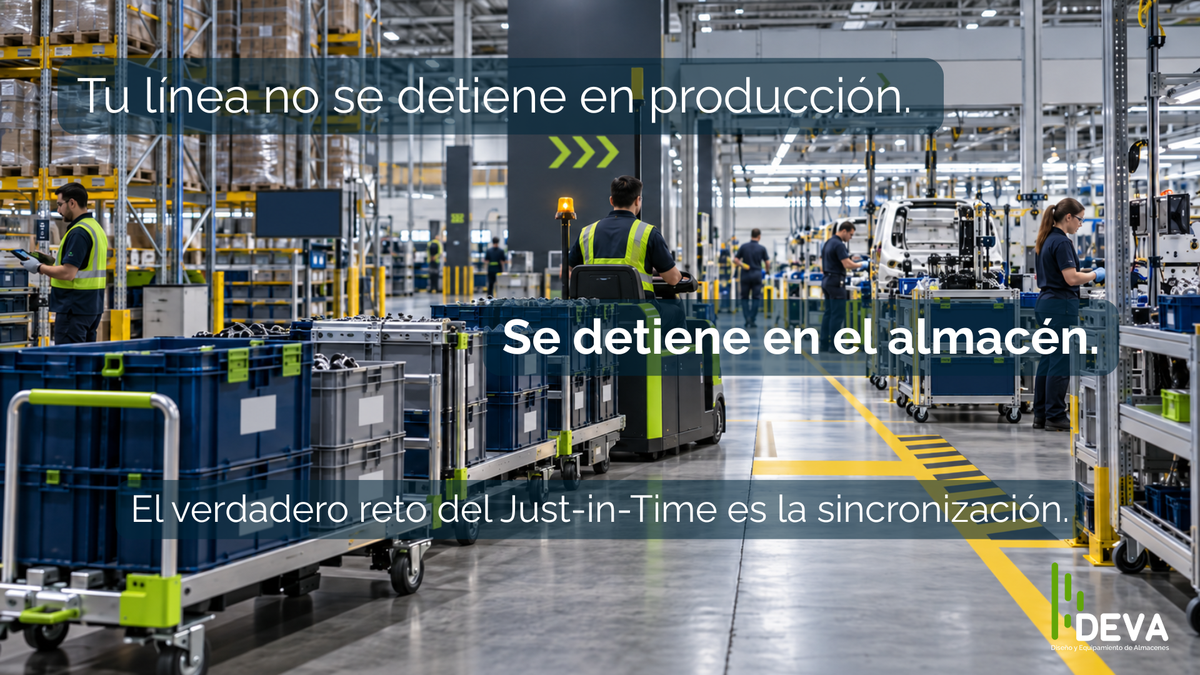
A line may have a defined takt time, scheduled suppliers and an optimized production plan; but if the warehouse cannot receive, locate, prepare and deliver materials at the pace the operation demands, all that discipline breaks down.
The warehouse is the point where inventory, information and physical movement must be synchronized. In a well-designed JIT operation, it stops being a place to “store” and becomes a system to supply.
Your warehouse can be the hero or the villain of your JIT operation.
Just-in-Time changes the role of the warehouse
The practical definition of Just-in-Time (JIT) is simple: produce only what is needed, when it is needed and in the quantity needed. In the Toyota Production System, this logic is one of the pillars of TPS and seeks to connect processes in a continuous flow, avoiding overproduction and unnecessary inventory.
The consequence for intralogistics is profound.
A conventional warehouse is usually measured by capacity: available positions, occupancy percentage and square meters used. A warehouse aligned with JIT must also be measured by its capacity to respond to the line’s actual consumption.
It is no longer enough to ask: “how much fits?” You have to ask: how quickly can I find, prepare and deliver what production needs?
The warehouse goes from storage depot to synchronized buffer: it receives, regulates, sequences and releases materials at the pace of production. It doesn’t store in order to “have.” It stores in order to deliver just in time.
In Mexico, this logic is especially relevant in the automotive, electronics, household appliance, medical device and pharmaceutical chains, where traceability, model changeovers and narrow supply windows demand coordination between production and intralogistics.
Every minute of misalignment has a price
When a line stops for lack of material, the cost is not just the value of the parts that didn’t arrive.
The cost of line downtime can include idle labor, unproductive equipment, units that were not manufactured, lost capacity, overtime to recover the schedule, expedited freight, rescheduling and possible impacts on customers.
There is no universal figure. It depends on the sector, the line’s capacity, the value of the product, the level of automation and the effect an interruption has on downstream processes.
As an example, imagine a line whose internal downtime cost is USD 2,500 per minute. A 20-minute interruption would equal USD 50,000. An hour would raise the impact to USD 150,000, before considering penalties, expedited shipments or plan recovery.
And in automotive, public benchmarks can be even higher. The Siemens True Cost of Downtime 2024 report estimates around USD 2.3 million per hour of unplanned downtime for automotive manufacturers.
The relevant question is not whether your line costs exactly that amount.
It is: how much does a minute of missing material really cost you, and have you measured it yet?
When the warehouse fails at the moment of delivery, it can become the weakest link in a chain that, on paper, looked perfectly synchronized.
The warehouse as a smart buffer: not storing, but dispensing
One of the most common mistakes is interpreting JIT as “zero inventory.”
JIT seeks to reduce waste and unnecessary inventory, not to eliminate all protection against variability. An operation with no margin for supplier delays, consumption fluctuations, quality problems or sequence changes can become extremely fragile.
That is why the warehouse must operate as a controlled buffer.
A buffer is not inventory accumulated out of habit. It is a quantity calculated to protect the flow. Its sizing must consider the lead time (the time from when a material is requested until it is available), consumption variability, supplier reliability, delivery frequency and the criticality of the component.
Safety stock must be calculated, not arbitrary.
“Let’s keep a week’s worth just in case” is not the same as defining how many hours or cycles of coverage a critical SKU needs according to its real risk.
In JIT, turnover also matters. A healthy warehouse aims for material to stay only as long as strictly necessary. High turnover means inventory comes in, gets processed and is consumed quickly, instead of turning into tied-up capital.
The goal is not to have less inventory at any cost.
It is to have the right inventory, with the right coverage and in the right position.
Designing the distribution center to feed the line
The layout of a JIT warehouse must be built backward from production consumption.
- Synchronized receiving. Arrivals should be organized in windows tied to the plan and expected consumption. If all suppliers arrive first thing in the morning “because it’s always been done that way,” receiving can become saturated even though production doesn’t need those materials yet.
- Sequenced storage. In highly sequenced operations, it may be worth organizing certain components in the order in which they will be consumed. This is where practices such as kitting (preparing together the components needed for an operation) and sequencing come in.
- Staging. It is a temporary area for preparation and controlled waiting before materials move to production. It allows you to consolidate kits, verify quantities and release material without turning the aisles into improvised zones.
- Direct routes. Every unnecessary meter adds time, congestion and cost. The flow should seek simple paths between receiving, storage, preparation and the point of use.
- Suitable aisles and equipment. They must be sized according to equipment, turning radii, crossings, pedestrians, replenishment frequency and required speed. Forklifts, tugger trains, transfer carts, conveyors or AMRs must fit the process, not the other way around.
Consider, for example, a Mexican automotive plant that schedules internal supply runs every 2-4 hours. If a SKU required for the next cycle is blocked behind low-turnover inventory, the problem is not necessarily a lack of capacity.
It is design and sequencing.
Five signs your warehouse isn’t ready for JIT
- First: excess inventory and shortages at the same time. The warehouse looks full, but production keeps waiting for critical SKUs.
- Second: lack of real-time visibility. The system shows stock on hand, but no one knows for sure where the material is, whether quality has released it or whether it is committed to another order.
- Third: slow picking. Every change in the sequence triggers searches, long walks or replanning.
- Fourth: rework. Incomplete kits, wrong materials, relabeling and urgent moves are part of the routine.
- Fifth: reactive operation. The team spends more time solving urgent issues than following a stable flow.
JIT self-assessment
- Can you tell within minutes which materials will feed each line over the next 2-4 hours and where they are physically located?
- Can your warehouse absorb a reasonable change in the schedule without relying on calls, manual searches or extraordinary moves?
- Do you measure line-feeding compliance (right quantity, right sequence and right time) and know the cause of every deviation?
If two or more answers are “no,” there is probably a gap between your JIT strategy and the warehouse’s real capacity.
Technology enables JIT; it doesn’t replace it
A WMS (Warehouse Management System) can provide real-time inventory, traceability, location rules, replenishment and dynamic task assignment.
But if the physical process is poorly designed, digitizing it will only make the problem more visible.
Integration with ERP and MES (Manufacturing Execution System, the system that controls and records production execution) allows the warehouse to receive signals much closer to the line’s actual consumption.
Barcodes and RFID reduce uncertainty about the identity and location of materials. Technologies such as voice picking, pick-to-light and put-to-light can speed up preparation and reduce errors when the operating profile justifies it.
AGVs and AMRs can automate repetitive moves between the warehouse and the line, especially on predictable or high-frequency circuits. But they require well-defined routes, priorities, safety measures, interfaces and operating rules.
The right technology reduces response time and increases reliability.
The wrong technology simply automates waste.
The three pillars of a JIT warehouse at DEVA
At DEVA, we approach the alignment between warehouse and production from three fronts.
- Flow analysis. We study movements from receiving to the point of use to identify unnecessary travel, waiting, double handling and congestion zones.
- Functional layout. We design the distribution center prioritizing flow, accessibility, sequence and operational proximity, not just storage density.
- Agile equipment. Racking, shelving, transfer carts, handling equipment and automation solutions are selected according to speed, frequency, unit load and the required level of precision.
The result we aim for is concrete:
Right material. Right quantity. Right time. Right point of use.
JIT also has to work in peak season
The real test of a system doesn’t always happen on an average Tuesday.
Product launches, year-end closes, temporary demand increases or changes in the mix can raise delivery frequency, picking volume and inventory turnover.
A warehouse that runs at its limit under normal conditions can collapse when the flow speeds up.
Before a season of higher demand, it is worth reviewing receiving capacity, staging areas, internal routes, critical positions, replenishment times, equipment availability, picking staffing and the physical condition of racks and storage systems.
It is also worth running capacity exercises.
What happens if volume rises by 20%?
Where does the first queue appear?
At receiving? Storage? Picking? Line feeding? Return of empties?
This type of analysis makes it possible to identify the bottleneck before the increase in demand reveals it in the worst possible way.
JIT does not mean operating without a margin. It means knowing where that margin is needed and controlling how it is used.
JIT is not just for normal days. It must also withstand high-demand days.
Conclusion: the warehouse produces too
Just-in-Time is not an isolated manufacturing philosophy. It requires suppliers, receiving, inventory, preparation, internal transport and the line to work with the same logic of time and consumption.
In Mexican manufacturing, the warehouse can become an operational advantage or a silent liability.
Having inventory does not guarantee availability.
Having space does not guarantee flow.
Having technology does not guarantee synchronization.
The question is: how is your warehouse feeding the production line today?
Is it truly operating under JIT, or does it still depend on JIC (Just in Case) to cover problems the process has not yet solved?
If you want to identify where synchronization breaks down between your distribution center and production, DEVA can run a diagnostic of your flow, layout and line feeding to detect improvement opportunities before they turn into shutdowns, emergencies or excess inventory.
Is your operation really working Just-in-Time, or does it still depend on “just in case”?
Ready to optimize your warehouse?
Talk with a DEVA expert and get a free personalized warehouse assessment.