
Material handling and the raw materials warehouse: the pair that defines your plant's efficiency
Chaos in a raw materials warehouse is not a space problem: it is a method problem. And the method is called material handling.
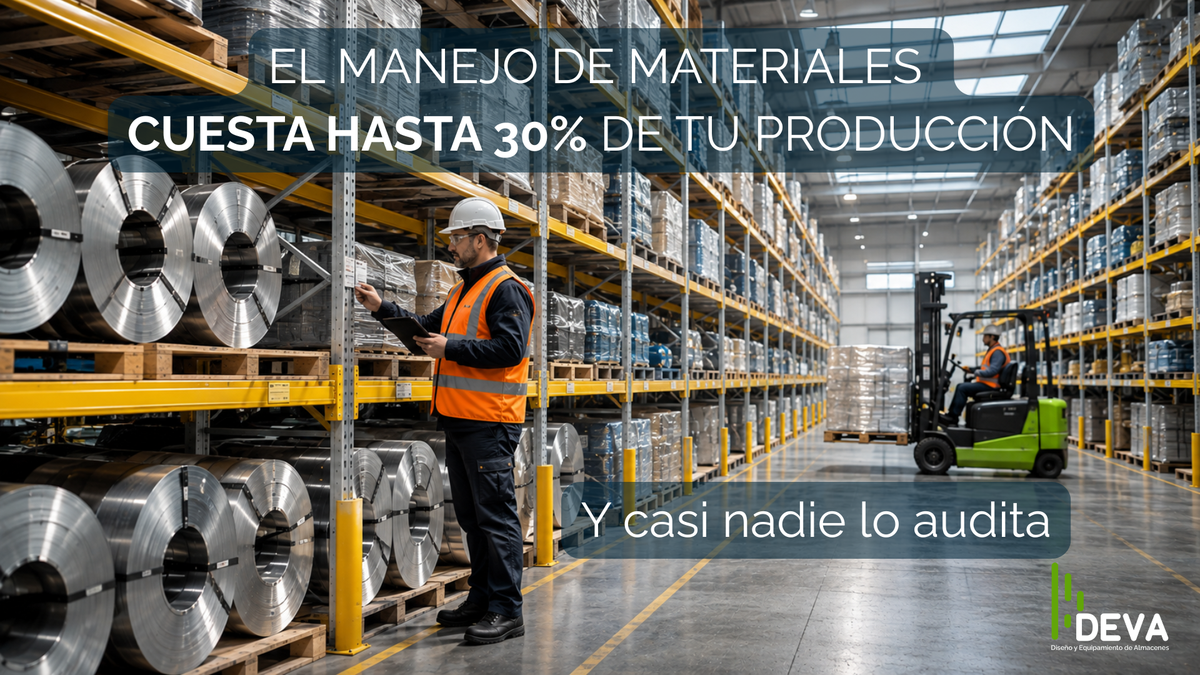
It’s a familiar scene: production stopped because no one can find the batch of steel that arrived last week, forklifts making extra maneuvers because the layout was never designed for the real flow of material, operators walking from one end to the other looking for resin that should be close at hand. The symptom seems to be a lack of space. The cause is almost always something else: there is no system.
Material handling is the set of methods, equipment and procedures used to store, protect, handle and move goods from the moment they enter the plant until they leave as finished goods. And the raw materials warehouse is where that system is put to the test for the first time. They are two sides of the same coin: let’s look at them together.
What is material handling and why is it the foundation of everything?
It’s not about “moving things from one place to another.” It is a system of methods for storing, protecting, handling and transporting goods along the entire chain, from the receipt of supplies to the delivery of the finished goods. Well designed, it reduces costs, improves safety, optimizes space and increases the productivity of the whole operation.
Why does it matter so much? Because every time a material is touched, moved or stored poorly, the plant pays a cost in time, product wear and risk to the operator. The Material Handling Institute (MHI), the international reference in the field, condenses best practices into ten principles, from strategic planning to the equipment’s life-cycle cost, which start from the same idea: material handling is a design decision, not an isolated operational task.
The 4 types of material handling equipment (and when to use each one)
Not everything is solved with a forklift. There are four major categories, and the right one depends on the type of goods, the volume and the frequency of movement:
- Storage and handling: pallet racking, boxes, containers and mezzanines. For when the challenge is density: storing more load in fewer square meters.
- Bulk material: belt conveyors, stackers and hoppers. Designed for resins, grains, aggregates or supplies that move by volume, not by unit.
- Industrial forklifts: counterbalanced trucks, turret trucks, order pickers and hand pallet jacks. Ideal for frequent movement of palletized loads between different areas of the plant.
- Automated systems: stacker cranes, AGVs (automated guided vehicles), AMRs (autonomous mobile robots) and sortation systems controlled by a WMS (warehouse management software). They are justified when volume and repetition make the investment profitable.
The right question is not “which equipment is best?” but which combination fits your type of material and your real volume.
Tangible benefits of good material handling
- Space optimization: more load in fewer square meters, freeing up area for production or growth.
- Lower operating costs: less internal transport, less redundant handling, faster picking. Material handling industry estimates put this item at between 20% and 30% of total manufacturing cost, one of the biggest and least monitored savings levers in a plant.
- Workplace safety: less physical effort, fewer accidents. In the United States, the Occupational Safety and Health Administration (OSHA) estimates about 34,900 serious forklift-related injuries a year and calculates that up to 70% could be avoided with proper procedures and training, a useful reference even outside that market: the risk rarely lies in the equipment, it lies in how it is used.
- Higher productivity: when material handling is well designed, operators stop solving layout problems and focus on producing.
How much is the material handling no one measures costing your plant?
The raw materials warehouse: the silent heart of production
It is the facility where basic materials (metals, fabrics, plastics, chemicals, resins) are kept before they enter the production process. It is not just any storeroom: it is the starting point of the entire value chain.
Its importance is strategic, not just logistical. If it is disorganized, production inherits that chaos: line stoppages, downtime spent looking for batches, rework from using the wrong material. That is why its location is no minor detail: it should be as close as possible to the production center, with access points that speed up both supplier deliveries and internal transfers.
Seven characteristics every raw materials warehouse must meet
- Strategic location: smooth access for suppliers and an efficient connection to the plant.
- Adequate capacity: enough physical and load space, designed to maximize efficiency, not just “to make it fit.”
- Temperature and humidity control: critical for sensitive materials whose quality degrades with ambient conditions.
- Efficient organization: real traceability, clear labeling, and a record of supplier and date for every batch.
- Proper handling: equipment and procedures that prevent damage during receiving, storage and transfer.
- Regulatory compliance: adherence to local industrial safety and environmental regulations.
- Flexibility: the capacity to adapt to changes in demand without redesigning the whole warehouse.
How many of these seven does yours meet today?
The goals of a raw materials warehouse (and how to measure them)
- Preserve and protect material quality, avoiding deterioration from mishandling or inadequate conditions.
- Ensure stock management by defining a safety stock (the minimum that prevents production stoppages) and a reorder point (the level that triggers the next purchase).
- Reduce losses and costs by applying FIFO (first in, first out) and actively identifying obsolete material before it becomes an accounting loss.
- Improve operational efficiency in receiving, storage, picking and dispatch.
How do you measure this? With simple indicators: receiving time, inventory accuracy, material turnover and production stoppages attributable to missing supplies. If no one in your plant can answer these four questions with a number, that is where your first improvement opportunity lies.
Practical checklist for organizing your raw materials warehouse
- Warehouse assessment: measure the available space, review the current design and honestly identify the problem areas; they are almost always the same two or three.
- Space planning: assign locations according to material type, special needs (temperature, weight, fragility) and frequency of use. What moves every day should not be at the back of the warehouse.
- Labeling and coding: a clear system that identifies material type, exact location and date of receipt or expiration, visible at a glance.
- Applying FIFO: the first goods in should be the first goods out, especially for materials with a limited shelf life.
A common example: a plant that manufactures metal furniture receives sheet steel from three different suppliers. Without labeling or FIFO, operators use “whatever is closest at hand” (almost always the newest batch), while the oldest material rusts in a corner. With batch coding and fixed locations by frequency of use, that same warehouse cuts picking times and eliminates losses from deterioration, without adding a single square meter.
The advantages of investing in a well-designed warehouse
- Greater production efficiency: fast access to the right material, without downtime spent looking for supplies.
- Space optimization: redesigning the layout and making use of the warehouse’s height can increase storage capacity by up to 30% without expanding the built area, a figure that consulting firms such as Logistics Bureau use as a reference when evaluating projects to reorganize racks and aisles.
- Lower costs: less wasted time, fewer picking errors, less material lost to expiration or obsolescence.
- Greater safety: a clean, orderly environment reduces accidents and makes supervision easier.
- Improved workflow: products that can be located and accessed in seconds, not minutes.
None of these advantages depends on building a new facility. It depends on rethinking how you use the one you already have.
At DEVA, we integrate material handling and raw materials organization as a single strategy, not as separate projects. Our methodology starts with a real analysis of the material flow in the plant, continues with the selection of equipment (racks, forklifts, automated systems) according to the type of operation, and ends with a layout design that connects receiving, storage and production without friction.
We don’t work with catalog solutions: every warehouse is designed around how material moves in that specific plant. The result is not just a place to store raw materials: it is a warehouse that boosts production instead of limiting it.
An efficient raw materials warehouse is not an operational luxury: it is a competitive necessity. The difference between a plant that flows and one that gets stuck almost always lies in these two disciplines, material handling and warehouse organization, working together.
Organization is not a back-office task: it determines the speed of your entire chain, from the moment the supplier delivers until the product goes out the door. Every minute an operator spends looking for material is a minute your plant is not producing.
How are you organizing your raw materials today? If you want an objective diagnosis of your industrial warehouse, DEVA can help you identify where the bottleneck is and how to solve it.
Ready to optimize your warehouse?
Talk with a DEVA expert and get a free personalized warehouse assessment.