
Operational Diagnosis: The Most Important Decision Before Investing in Your Warehouse
Before spending a single peso on new racking, state-of-the-art forklifts or complex automation systems, you need to understand exactly where money is being lost today. In the fast-paced world of intralogistics, the urgency to "grow" or "modernize" often clouds strategic reasoning. Many operations directors and supply chain managers fall into the trap of applying standard solutions to problems they have not even finished understanding.
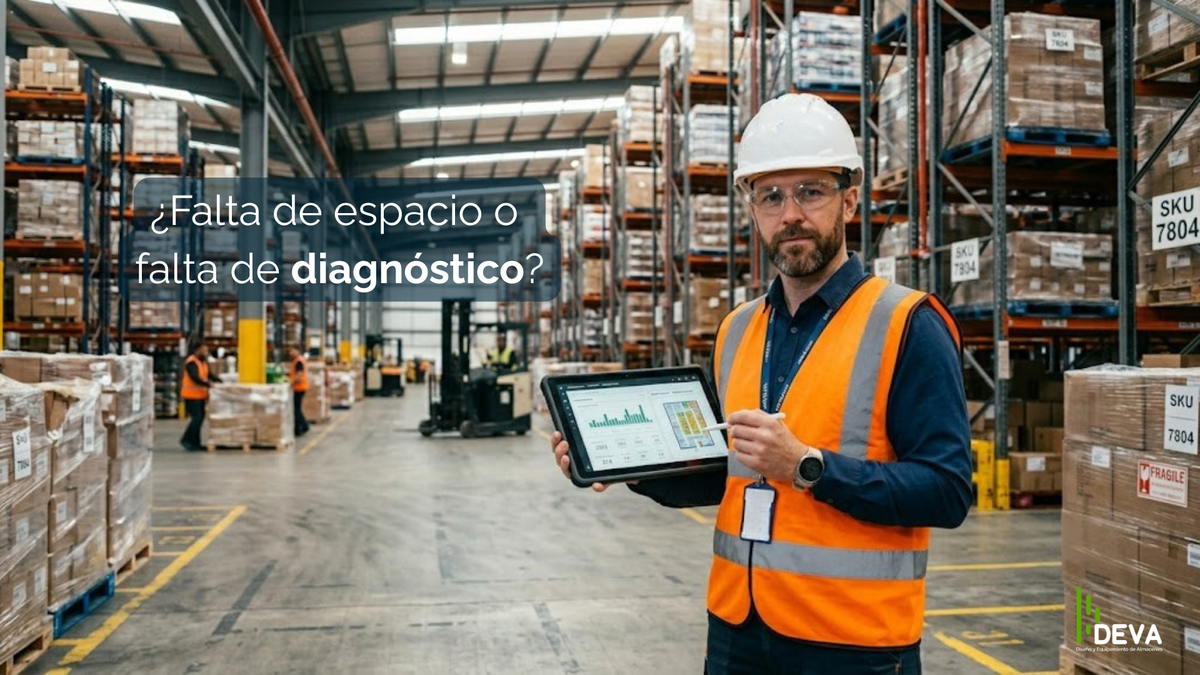
Investment in logistics infrastructure is, by nature, capital-intensive and long-term. A mistake in choosing a storage system is not just a poorly executed expense, but an anchor that will hold back the agility of your supply chain for the next ten or fifteen years. This is where the operational diagnosis stops being a “nice-to-have” option and becomes the fundamental pillar of profitability.
Throughout this article, we will analyze why the diagnosis is the most powerful tool for protecting the budget and how a prior analytical view can radically transform the efficiency of your distribution center. It is not about buying more steel, but about managing space and time better.
The invisible cost of not looking before you leap
Investing without a prior diagnosis is, in essence, playing Russian roulette with the company’s cash flow. Walking through plants and warehouses across various sectors, we have observed a worrying pattern: up to 30% of the fixed-asset investment budget is lost on solutions that do not attack the root cause of the problem.
Imagine a consumer goods company that, faced with a saturated warehouse, decides to invest one million dollars in high-density racking systems (drive-in). Six months later, they discover that their service level has dropped and their dispatch times have doubled. The reason? They did not analyze their inventory profile. They had high SKU turnover with critical expiration dates, and the chosen system eliminated the necessary selectivity, creating a logistics nightmare of “double handling” to reach the right product.
The cost of not diagnosing is not just the value of the wrongly purchased equipment. It is the opportunity cost, the loss of productivity and the spending on rework. A poorly sized rack or an underused technology are monuments to inefficiency that will remind management every day that a decision was made based on assumptions, not data. When the symptom is “lack of space”, the solution is not always “more racking”. Sometimes, the solution is a purge of obsolete inventory or a reconfiguration of picking flows.
What is an operational diagnosis in the warehouse, really?
There is a common confusion between a superficial audit and an in-depth operational diagnosis. While an audit usually verifies that current processes are being followed (compliance), a diagnosis questions whether those processes are the right ones for the business objectives (optimization).
A comprehensive operational diagnosis must break the operation down into its smallest atoms to understand how they interact with each other. The key components include:
- Flow and process analysis: Detailed mapping from receiving to dispatch. How many times is a product touched before it leaves? Every “touch” has a cost.
- Cycle times: Real measurement of how long it takes to process an order. Identifying where the flow stops (the famous bottlenecks).
- Density vs. selectivity: A technical analysis of cubic space use compared with the accessibility the SKUs require according to their ABC classification.
- Staff productivity: It is not about “watching”, but about understanding whether the current warehouse design forces staff to make unnecessary trips. In many undiagnosed warehouses, workers spend 60% of their time walking and only 40% performing value-added tasks.
- Order and inventory profile: Historical demand analysis to understand seasonality and the variations that impact the daily operation.
An in-depth diagnosis delivers a thermal snapshot of the operation: it shows where there is “heat” (productive activity) and where there is “cold” (wasted resources).
Avoiding overinvestment: The power of data over steel
One of the biggest benefits of carrying out a diagnosis is that it often reveals the solution does not require a massive investment. There is a natural tendency to think that logistics problems are solved by buying “things”: more square meters, more racking, more technology.
Practical case of operational transformation:
A distribution center in the spare parts sector planned to purchase and install 500 new rack positions to absorb projected growth of 20%. The budget was considerable and the implementation time threatened to stop the operation.
After carrying out a serious operational diagnosis, the data revealed something different: 35% of the current storage space was occupied by products with zero turnover (dead inventory) and the layout forced pickers to cross the entire warehouse for high-turnover items.
The result of the diagnosis:
Instead of buying the 500 rack positions, the proposal was:
- A strategic relocation based on turnover velocity (slotting).
- The implementation of a high-density picking zone for the top 20% of SKUs.
- An inventory management policy to purge obsolete stock.
The client gained 40% in operating capacity without spending a peso on heavy infrastructure. The ROI of this diagnosis was practically immediate, while the racking purchase would have been an investment with a 5-year return that, on top of that, would not have solved the slow picking.
Critical signs: Is your warehouse crying out for a diagnosis?
Many logistics leaders get used to “operational chaos” and see it as a normal part of the business. However, there are clear signs that your operation is running below its potential and that an investment without a diagnosis would be a mistake:
- Frequent lost or “phantom” inventory: If the system says there is stock but it cannot be found physically, or vice versa, your problem is not lack of space, it is lack of process control.
- Rising order picking times: If you need more and more time (or more people) to get the same number of orders out, you have a structural bottleneck.
- Extra operations outside working hours: The constant use of overtime to “catch up” is a clear symptom of an operation that has lost its natural flow.
- Aisle saturation: If goods start to invade maneuvering aisles or receiving/shipping zones, the risk of accidents increases and productivity plummets.
- Staff turnover from fatigue: A poorly designed warehouse is physically exhausting. If your staff quits because travel distances are inhumane, your layout is failing.
If you identify two or more of these signs, stopping to diagnose is the only responsible course of action before approving any investment budget.
The DEVA approach: Diagnose to design with precision
At DEVA, we have adopted a clear philosophy: we are not simply equipment suppliers, we are partners in the efficiency of your supply chain. We understand that a rack is just a tool, and like any tool, its value depends on how well it fits the task.
Our diagnostic process does not start with a product catalog, but with an immersion in your data. The DEVA methodology rests on three pillars:
- Real data collection: We analyze your transactions, your load dimensions and your growth projections.
- Scenario simulation: Before installing the first bolt, we model how the operational flow will behave with different layout configurations.
- Agnostic proposal: If the diagnosis indicates that you do not need new racking, but rather a reconfiguration of processes, we will tell you. Our goal is for every peso you invest to have a direct impact on your profitability.
Getting a diagnosis from DEVA before requesting a quote for any solution lets you move from the position of “equipment buyer” to that of “logistics strategist”. We give you the technical and financial arguments to support your decisions before executive management.
Conclusion: Diagnosis is the most profitable investment
In conclusion, the operational diagnosis is not an expense, it is the life insurance of your investment. In an economic environment where efficiency is the only sustainable competitive advantage, deciding based on intuition is a luxury no company can afford. An accurate diagnosis will save you money, time and frustration, ensuring that your warehouse is not just a storehouse of boxes, but a growth engine for your company.
Before taking the next step in expanding or modernizing your logistics center, ask yourself: Am I solving the problem, or just buying more steel to hide it? The answer is in the data.
Have you noticed bottlenecks in your operation that you can’t solve with more staff or equipment?
Ready to optimize your warehouse?
Talk with a DEVA expert and get a free personalized warehouse assessment.