Rack Audits: When to Do Them, What to Look For and Why You Can't Let Them Slide in Peak Season
A damaged rack that collapses in peak season is not just an accident. It is the shutdown of your operation at the worst possible moment.
As you read this, your warehouse is probably running at an intense pace. Forklifts are moving, goods go up and down, and the steel structure that holds your inventory works in silence. That structure is the skeleton of your logistics. Yet in the daily rush, it is easy to assume that racks last forever, that metal doesn’t fatigue and that “the way they were installed is the way they’ll keep working.”
The operational reality in Mexico is far from that assumption. Many distribution centers grew organically, adding levels, changing pallets or increasing load density without recalculating structural capacity. Racks get installed, filled and forgotten.
Today we suggest a 10-minute pause to ask yourself an uncomfortable question: When was the last time you thoroughly inspected your racks?
We don’t mean a quick glance while you walk to the dock area. We mean a rigorous, documented technical analysis. Because if the answer is “never” or “I don’t remember,” you are operating with a structural time bomb. And in peak season, that bomb has a very short fuse.
What is a rack audit and why is it not a luxury?
In practical terms, a rack audit is a systematic inspection of the structure, connections, anchors, material condition, deformations and load capacity of your storage systems. It is a diagnosis of structural health.
But not all audits are the same. There is a huge difference between what an operator sees and what an engineer sees:
- Daily Visual Audit (Operational): This is the “routine check.” It looks for obvious, recent damage: a beam bent by a forklift impact, a visibly protruding bolt or a load about to fall. It is reactive and immediate.
- Deep Technical Audit (Engineering): This is the “diagnostic study.” It measures column deviation (bowing), analyzes the condition of the chemical or expansion anchors in the concrete, assesses internal corrosion and compares the actual load with the nominal design load. It is preventive and predictive.
This is where Mexican reality comes in. Our logistics sector has grown at a dizzying pace. In this rush, structural maintenance of racks is rarely included in the operating budget. According to data from the STPS (Mexico’s Ministry of Labor and Social Welfare), unsafe conditions in storage structures and material handling are among the leading causes of workplace accidents in the country. It is not a matter of looks or tidiness; it is a matter of compliance and lives.
The cost of not auditing: accidents, shutdowns and lawsuits
Not auditing is expensive. Always. The problem is that the cost is paid all at once, with interest.
- Human Risk: A collapse gives no warning. When a forklift hits an already fatigued column or an earthquake shakes a faulty anchor, the fall is instantaneous. The consequences are serious injuries, permanent disabilities or, in the worst-case scenario, deaths. No productivity indicator justifies that risk.
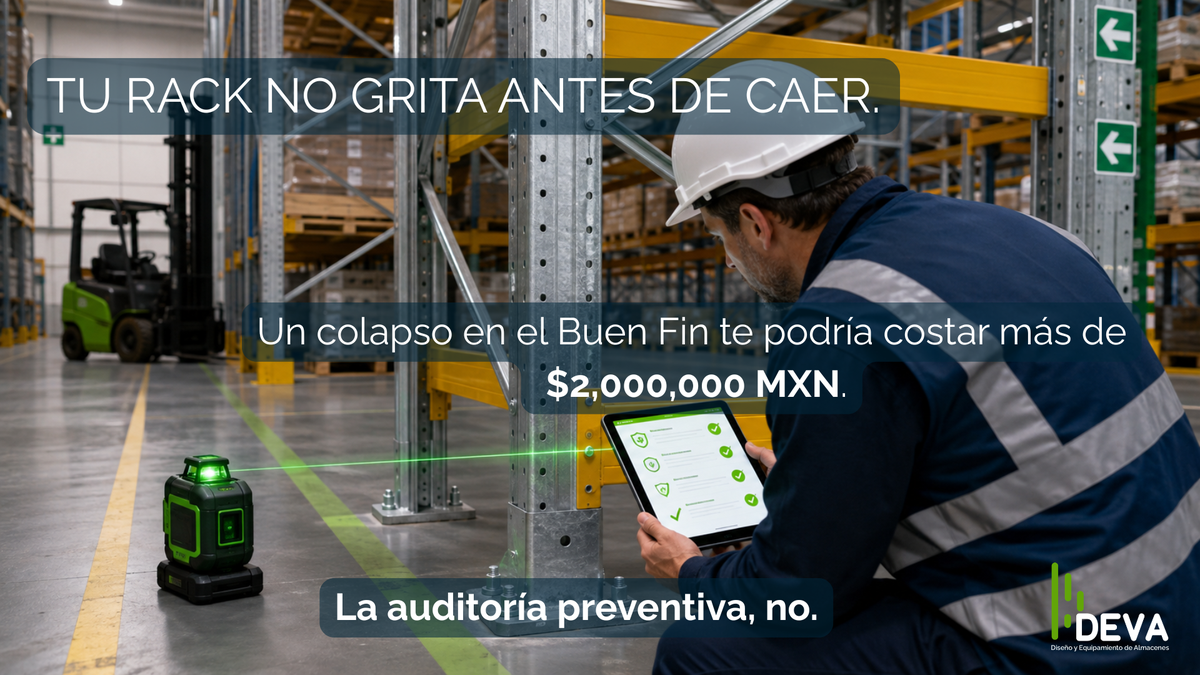
- Operational Risk: Think of El Buen Fin. Your distribution center is at 100% of its capacity, the aisles are full and every minute counts. If a rack collapses at that moment, you don’t just lose the goods that fell. The area is shut down for days for investigation, cleanup and securing. The entire operation slows down or stops completely just when you have the most sales to process.
- Financial Risk: The bill for a collapse is astronomical. First, the destroyed inventory. Second, accident compensation. Third, STPS fines for noncompliance with NOM-006-STPS (material handling) or general safety conditions. Fourth, the increase in insurance premiums. And watch out: many insurers refuse to cover losses if a lack of preventive maintenance or structural negligence is proven. To give you a realistic reference: a rack collapse can cost between $500,000 and $2,000,000 Mexican pesos in direct losses, not counting collateral damage or lost sales. In peak season, that figure multiplies exponentially.
- Reputational Risk: When a supplier or customer finds out there was a collapse in your warehouse, trust breaks. No one wants to risk their goods in an operation that doesn’t take care of its infrastructure.
When should you do a rack audit? (Minimum schedule)
The audit should not be a one-off event, but a schedule of continuous supervision:
- Daily Visual Audit: At the start of every shift. The supervisor or floor lead should walk the aisles and verify there is no visible damage from recent impacts or obvious overloads. Time investment: 5 minutes.
- Semiannual Technical Audit: Every 6 months. It must be performed by qualified personnel (a structural engineer, a certified expert or a specialized supplier). This is where material fatigue that the untrained eye can’t see gets detected.
- Deep Annual Audit: Once a year. It includes precise measurement of deformations (plumb line, laser level), torque tests on anchors, corrosion analysis and comparison with the original load drawings.
- Extraordinary Events (Immediate Audit): This is where Mexico forces us to be strict. If there was an earthquake (we live in a highly seismic country), a severe forklift impact against a column, an accidental overload, or a significant change in the type of inventory (for example, going from light boxes to heavy metal pallets), the audit is mandatory and immediate.
The golden rule: Before every Peak Season (El Buen Fin, Hot Sale, year-end close), you must have a recent technical report in hand. You can’t enter the demand peak with structures in doubt.
What should you look for in an audit? (Essential technical checklist)
If you walk through your warehouse today and want to start identifying risks, focus on these critical points:
General Structure
Columns, beams and diagonals that are bent (twisted), dented or kinked. If a column buckles, its load capacity drops drastically.
Connections
Loose bolts (they move to the touch), broken welds with visible cracks, or deformed beam connectors. A failed connector lets go of the beam.
Floor Anchors
Loose expansion or chemical bolts. Look for corrosion at the base, cracked concrete around the anchor or a gap between the base plate and the floor.
Load Capacity
Actual loads must never exceed the capacity plate (technical name: nominal load plate). Check that no more levels are being stacked than allowed.
Paint Condition
Advanced rust or flaking. Paint is not decoration; it is the anti-corrosion barrier. If the steel is peeling, it is weakening at the molecular level.
Clearances
Racks too close to walls, ceilings or each other. In an earthquake or from vibration, the rack strikes the building structure and deforms.
Protection
Impact guards (posts, traffic barriers). Do they exist? Are they destroyed or buried? A rack without a guard is an accident waiting for the forklift to pass.
Signage
Visible, legible load plates. If the forklift driver doesn’t know how much the level can hold, they will probably overload it.
The seismic factor: why it is even more critical in Mexico
We can’t talk about racks in Mexico without talking about earthquakes. Mexico City, Guerrero, Oaxaca, Jalisco, Puebla and many other areas are highly seismic. An earthquake is not a static “blow”; it is an undulating, repetitive movement that punishes the structure.
A rack poorly anchored to the concrete, or with bracing (the Saint Andrew’s “crosses” that provide lateral stability) poorly placed or loose, becomes a pendulum. At the moment of the earthquake, the live load (the inventory) moves, and if the structure is not fixed to the floor, it collapses from lateral fatigue.
This is where local regulations become vital. NOM-025-STPS-2008 (lighting conditions) does not apply, but the structural criteria of the RCDF (Building Code of the Federal District) and its Complementary Technical Standards for the seismic design of industrial buildings do. Your audit must verify that the original seismic design is still valid and that the anchors have not loosened over time.
Who should do the audit? (Why you can’t let it slide)
Here is the most common mistake in Mexican industry: letting structural safety slide. The thinking goes: “The operator sees the racks every day; if something were wrong, he’d tell me.”
Wrong. The operator is focused on moving boxes, not on measuring millimetric deformations. “Looking” at the racks is not enough. You need trained personnel: a structural engineer, a certified storage systems expert, or a specialized supplier (such as DEVA) that understands the mechanics of materials and load dynamics.
In addition, the audit doesn’t exist if it isn’t documented. If there is an accident tomorrow, the STPS will ask you for evidence. “I thought they were fine” is not a legal defense. You need a written report with photos, measurements and a corrective action plan. Leaving the inspection to “we’ll check it later” is a death sentence for your operation.
Peak season: the moment of highest risk
Why do we insist so much on El Buen Fin, Hot Sale or year-end? Because physics doesn’t negotiate.
In peak season, racks are loaded to 100% of their capacity or more. Inventory is dense, pallets are heavier and space is minimal. At the same time, staff work under maximum pressure: forklifts go faster, turns are tighter and impacts against structures increase exponentially.
If your structure had an invisible crack in January, by November that crack has become a fatigue fracture. And with the pressure of the season, that fracture gives way.
A collapse in October causes an operational shutdown. A collapse in the middle of El Buen Fin knocks you out of the market. You lose millions in revenue, furious customers go to the competition and your logistics team is plunged into chaos. The pre-season audit is not an expense; it is the cheapest insurance premium you will pay to guarantee the continuity of your business.
The DEVA audit process: your ally before the peak
At DEVA Diseño y Equipamiento de Almacenes (warehouse design and equipment), we see it every day. Our job is not to sell fear; it is to build certainty. When a client asks us for a preventive audit, we activate a rigorous technical protocol:
- Detailed Visual Inspection: A thorough walkthrough looking for physical damage, impacts and visible deformations.
- Deformation Measurement: We use plumb lines and measuring equipment to detect deviations outside the standard.
- Anchor Verification: We check bolt torque and the integrity of the concrete.
- Load Analysis: We compare the rack’s current configuration with the design drawings and the nominal capacity. If inventories have grown, we recalculate.
- Bracing Review: We confirm that the structure is properly stiffened for a seismic zone.
We deliver a technical report with the findings color-coded: Urgent (Red), Schedulable (Yellow) and Observation (Green). We don’t leave you alone with the problem; we propose the solution: repair, reinforcement or replacement of components.
The decision is in your hands
A rack doesn’t bend overnight. It fatigues, corrodes and weakens silently for months while the operation goes on. Peak season is the worst time to discover that your infrastructure didn’t hold up.
Your team’s safety, your customers’ trust and your distribution center’s profitability depend on a decision you can make today. Don’t wait to hear the roar of twisting steel.
How often are racks audited in your operation? Have you experienced or witnessed an incident caused by a lack of structural maintenance? And if you feel it’s time to shield your operation before the next El Buen Fin, send us a direct message. At DEVA, we help you diagnose your structures and correct course before it’s too late.
Because in intralogistics, as in life, what isn’t inspected deteriorates.
Ready to optimize your warehouse?
Talk with a DEVA expert and get a free personalized warehouse assessment.