
Returns Management (Reverse Logistics): The Process Mexican E-commerce Forgot to Design
Every return that enters your distribution center without a defined process contaminates your outbound operation. Do you have a zone and a flow to receive returns?
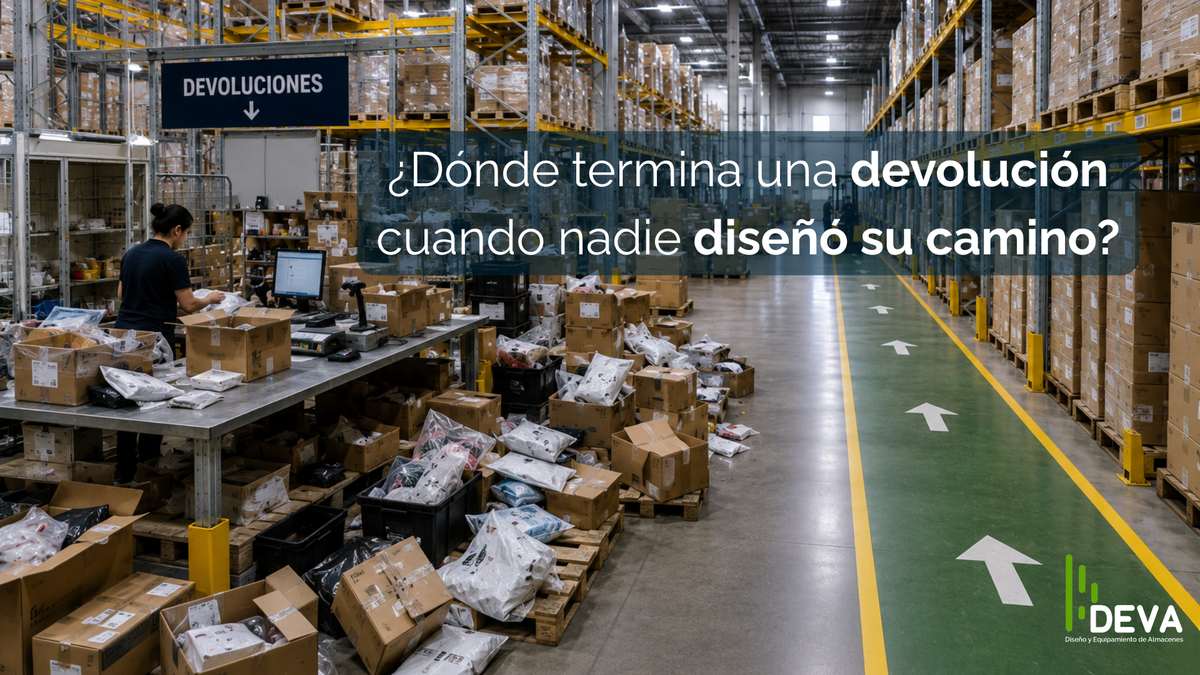
The scene repeats itself every day: an operator receives a returned box, checks the label and asks where to put it. Nobody has a clear answer. The box ends up next to packing, behind a table, in an aisle or on a pallet provisionally marked with a sheet of paper.
It looks like a minor incident. It isn’t. That return has just entered an operation designed to receive inventory from suppliers and dispatch orders, but not to process products that come back with different conditions, causes and destinations.
From there, the contamination begins: outbound staff interrupt their work, the inventory is left in an ambiguous status, operating space gets taken up and the risk grows that a damaged item will go back into sellable stock.
The problem is not that returns exist. In e-commerce they are a natural part of the business. The problem is having built an outbound highway without designing the return lane.
The rebound effect: selling more also means receiving more
Mexican e-commerce is no longer a secondary channel. In 2025, online retail sales reached approximately $941 billion pesos, with annual growth of 19.2% and more than 77 million digital shoppers, according to AMVO. Campaigns such as Hot Sale and El Buen Fin concentrate order peaks that, weeks later, generate a second wave: exchanges, rejections and returns.
The pandemic accelerated adoption, and many Mexican companies invested in picking, packing, last mile and dispatch capacity. However, few designed the return of products (for the wrong size, damage, a picking error, a technical fault or customer rejection) with the same level of detail.
As an international reference, online returns can be around 20% and, in fashion and footwear, exceed 20-30% in certain business models. In electronics, the percentage varies widely by subcategory and campaign, so applying a single rate is not advisable.
Operational diagnostics of Mexican distribution centers often reveal a worrying sign: about 6 out of 10 facilities reviewed do not have a truly independent returns zone. This reference point should be understood as a field observation, not a national census, but it reveals a clear pattern: outbound grew faster than return capacity.
What does it mean to “contaminate” the operation?
A return is not available inventory, but it is not waste either. Until someone registers, inspects and sorts it, it remains in operational limbo. When that limbo shares space, people and equipment with outbound, it starts to contaminate the distribution center.
First come the bottlenecks: the picker stops to open boxes, look up orders or move returned goods. Then come the inventory errors: the customer has already returned the unit, but the system shows it neither as available nor as blocked.
There is also a quality risk when opened, incomplete or damaged items are mixed with new product. Finally comes spatial chaos: boxes in aisles, pallets in front of racks and packing tables turned into inspection zones.
It is like running a highway with a shared on-ramp and off-ramp at rush hour. Returning vehicles cut across the lanes of those trying to move forward. The problem is not volume by itself; it is the lack of separation and traffic rules.
The hidden cost: a return never costs just the freight
A sale follows a relatively uniform flow: pick, pack, document and dispatch. A return, by contrast, may require return transport, receiving, validation, opening, inspection, sorting, cleaning, repacking, relabeling, repair, relocation, return to the supplier or destruction.
That is why the logistics cost of a return can be 2 to 3 times higher than the cost of the original shipment. Complexity increases because each unit can take a different path and because its value deteriorates while it waits for a decision.
Consider an illustrative example. A distribution center receives 500 returns a day. If the logistics cost of the original shipment was $85 MXN and processing the return costs 2.5 times that amount, each return represents approximately $212.50 MXN.
That equals $106,250 MXN a day in reverse processing. An improvement of just 15% through faster sorting, fewer movements and better recovery would represent about $15,938 MXN a day, or more than $4.1 million pesos a year, based on 260 operating days.
This is not a universal projection. It is an exercise to size up where the cost is hiding.
If a product fit for resale takes 7 days to return to stock, a week of commercial availability is lost. In addition, a distribution center with 500 returns a day and no defined flow can lose up to 2 operating hours a day reorganizing space and resolving exceptions.
On top of that time come other costs that rarely appear together in the same report:
- Inventory cost: products that physically exist but cannot be sold yet.
- Quality cost: items that deteriorate from stacking, handling or improper storage.
- Labor cost: operators trained to pick orders who end up dealing with returns.
- Opportunity cost: high-turnover or seasonal goods that lose value while waiting for inspection.
The five steps every reverse flow must include
Reverse logistics is not solved by setting up a table and a sign. It needs a physical and digital sequence that reduces improvised decisions.
Receiving and registration
The return must arrive in an area separate from supplier receiving. The first step is to scan it, link it to the order, identify the source channel and record the reason.
Rule of thumb: no unit should enter the distribution center without a digital status.
Inspection and sorting
Inspection tables, adequate lighting, tools and visible criteria make it possible to determine whether the item is fit for resale, refurbishable, repairable, returnable to the supplier, recyclable or disposable.
Sorting must be based on clear rules, not on the opinion of the operator or the shift.
Refurbishing and repacking
Fashion may require folding, steaming, bagging and a new label. Cosmetics demand strict integrity controls. Electronics may need a functional test, accessory validation and secure data erasure.
The space and the equipment must match the category. A garment is not processed the same way as a phone, a household appliance or a personal care product.
Relocation or disposition
Every sorting decision must trigger a specific destination: sellable inventory, quarantine, repair, liquidation, supplier, recycling or destruction.
A return without a destination and a time limit becomes dead inventory.
Credits and accounting
The physical flow must connect with invoicing, marketplaces, customer service and finance. The refund or replacement should not depend on emails, spreadsheets and calls between departments.
When the product has already been received but the refund is still on hold for lack of information, the operational problem also becomes a customer experience problem.
The “toxic zone”: hiding returns is not managing them
The most common mistake is putting returns in whatever corner was left over at the end of the layout: with no easy access, far from the system and with no capacity to absorb peaks.
That corner becomes “toxic” because it piles up pending decisions and goods with no priority.
Another mistake is using the same picking staff. In practice, the two functions compete for attention: outbound demands speed and repetition; returns demand diagnosis and exception handling. Mixing them reduces the performance of both.
Returns should also be separated by channel. A marketplace return may have different deadlines, evidence and rules from those of the company’s own store or physical network. Without traceability by source, disputes, incorrect credits and breaches increase.
The solution is to treat the reverse logistics zone as a sub-warehouse within the distribution center, with its own flow, responsible staff, capacity and metrics.
At a minimum, the following should be measured:
- Time from receiving to inspection.
- Total return cycle time.
- Percentage of product recovered.
- Percentage written off as shrinkage.
- Cost per return.
- Age of inventory in quarantine.
What isn’t measured stays piled up until someone needs to free up the space.
Technology to decide faster, not to digitize chaos
A WMS with a returns module can automatically assign a location and a route based on the product’s condition, category, channel and commercial policy.
This keeps every unit from following the same path and makes it possible to prioritize items with higher value, turnover or depreciation risk.
Barcodes or RFID make it possible to track each product from the moment it crosses receiving until it is reintegrated, repaired, returned to the supplier or discarded.
Traceability is especially useful when a box contains several units or when there are consolidated returns from branches.
Photos at the inspection point document the condition and reduce disputes. Integration with ERP, invoicing and customer service speeds up refunds and replacements, so that inventory, customer and accounting reflect the same reality.
But technology does not replace design. Installing a returns module on a space with no capacity, crossing routes and ambiguous criteria only digitizes improvisation.
The process must be defined first. Then you determine which technology will help execute and measure it.
How DEVA builds the reverse flow in from the drawing board
At DEVA, reverse logistics is considered from the conceptual design of the distribution center, not as a patch added once the aisles are already saturated.
The starting point is analyzing historical return volumes by category, channel, season, cause and condition. With that information, we size temporary positions, inspection tables, quarantine zones, racks for returns, transfer carts and independent circuits.
The zone is then connected to receiving, sellable inventory, repair and final disposition, with the aim of reducing crossings and staying flexible for Hot Sale, El Buen Fin and other peak seasons.
Based on internal project references, a redesigned reverse flow can reduce processing time by up to 40% and free up picking capacity by up to 15%, depending on the volume, the product mix and the initial level of disorder.
In a confidential retail reference case in Mexico City, the return cycle went from approximately 48 hours to 8 hours after separating the flow, establishing inspection criteria and assigning clear destinations.
The result did not come from working faster. It came from eliminating waiting, travel, unnecessary movements and repeated decisions.
Returns are not an exception: they are part of the design
In Mexican e-commerce, a return does not necessarily represent a mistake. It is an expected consequence of selling at a distance, running promotions, operating several channels and offering a competitive customer experience.
The strategic mistake is treating it as an occasional event. Designing for the reverse flow is as important as designing for the outbound flow: both consume space, people, systems, equipment and decision-making capacity.
The question is not how many returns you can hide before peak season ends. The question is how much value you can recover and how quickly you can return it to the business.
In your distribution center, do returns have their own “highway,” or do they mix with outbound? Tell us how you handle it.
If your operation needs to size, separate or redesign this flow, contact DEVA to request a no-obligation reverse logistics assessment.
Ready to optimize your warehouse?
Talk with a DEVA expert and get a free personalized warehouse assessment.