Seismic calculations for warehouses: what every operation in Mexico should know before installing a rack
The September 19, 2017 earthquake didn't just bring down buildings in Mexico City; it also exposed an uncomfortable truth for many industrial operations: a warehouse can look orderly, productive and profitable… until a seismic force tests everything that was never calculated.
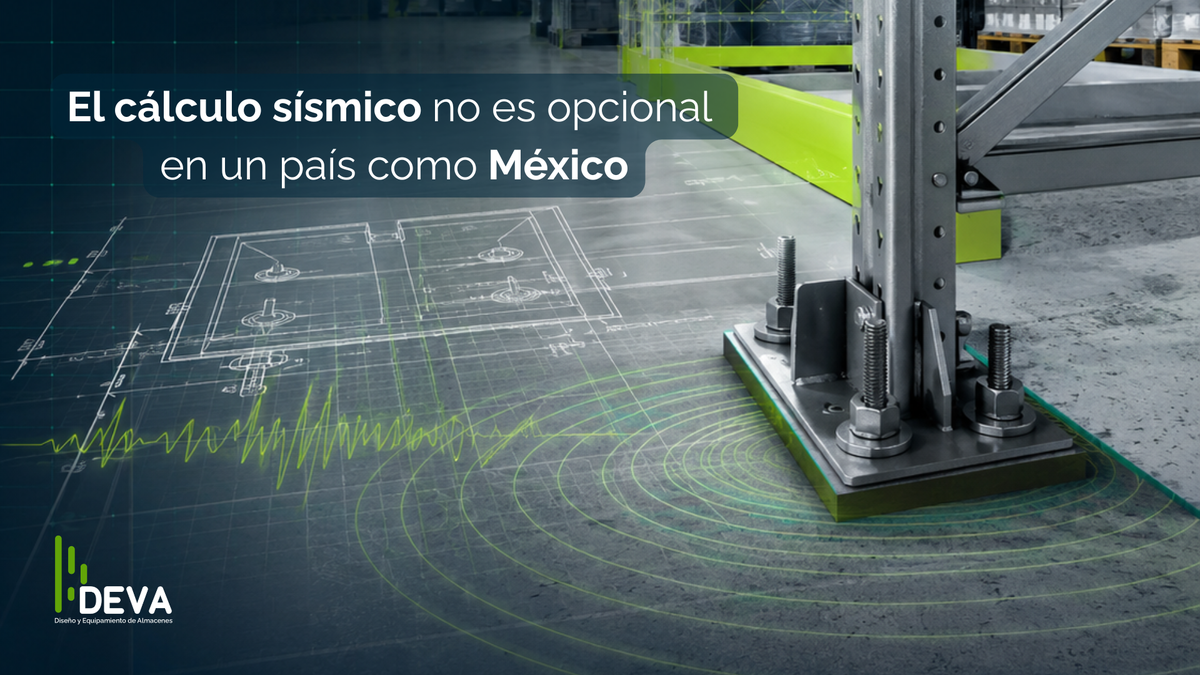
In Mexico, structural safety is not a theoretical topic. It is an urgent conversation for any company that stores tons of product on multilevel racks, runs forklifts in narrow aisles or concentrates critical inventory in a distribution center located in Mexico City, the State of Mexico, Puebla, Guerrero, Oaxaca, Chiapas, Jalisco or Michoacán.
The uncomfortable question is simple: is your warehouse ready for the next earthquake in Mexico?
This is not about spreading fear. It is about responsible prevention. Because when a rack fails during an earthquake, it is not just steel that falls: inventory falls, the operation stops, people are put at risk and the continuity of the entire supply chain is compromised.
Why seismic calculation is critical in Mexican warehouses
Mexico sits in one of the most seismically active regions on the continent. The interaction between the Cocos, Rivera, Pacific, North American and Caribbean plates generates constant activity that particularly affects the center, south and west of the country.
This makes places such as Mexico City, Guerrero, Oaxaca, Chiapas, Jalisco, Michoacán, Puebla, Morelos and the State of Mexico especially relevant, since many industrial operations, distribution centers, pharmaceutical warehouses, retail warehouses and manufacturing plants there concentrate large volumes of goods.
A warehouse does not behave like an office. Its structural risks are different. There are racks over 8, 10 or 12 meters tall, loads concentrated at specific points, aisles with mobile equipment moving through them, vibration from daily operation and, in some cases, direct interaction between the racking, the slab, the walls, the roof and the fire protection system.
Add to this a common problem: many companies treat racks as industrial furniture when they are actually steel structures that carry tons. Loaded selective racking, a drive-in system, a push-back system or a high-density structure cannot be evaluated only by “capacity per level.” They must be analyzed for their full structural behavior.
As a market reference, some specialists estimate that up to 60% of industrial warehouses in Mexico could be operating with some level of noncompliance or incomplete documentation on seismic safety. It is not an official figure, but it is a warning sign: many operations have grown out of urgency, through successive expansions or through load changes that were never recalculated.
Seismic regulations in Mexico: “it will hold” is not enough
In Mexico there is no single universal standard for all racks in every state. Seismic design must start from a combination of local regulations, technical standards, structural criteria and international standards applicable to the type of system.
For Mexico City, the most important regulatory basis is the Building Code for the Federal District (Reglamento de Construcciones para el Distrito Federal), still known as the RCDF, together with its Complementary Technical Standards, especially the NTC for Seismic Design. In Mexico City, these criteria are particularly strict because of the complexity of the soil and the experience accumulated after the 1985 and 2017 earthquakes.
At the national level, the CFE’s Civil Works Design Manual (Manual de Diseño de Obras Civiles) is a fundamental reference for seismic hazard criteria, design spectra and structural behavior across the country’s regions. Although it was developed for civil works and infrastructure, its criteria are widely used by structural engineers as a technical basis for industrial projects.
Mexico’s Official Standards (NOMs) on workplace safety must also be considered. It is important to be precise here:
- NOM-006-STPS-2023 regulates storage and material handling with machinery, with a focus on workplace safety conditions.
- NOM-001-SEDE-2012, on electrical installations, can be indirectly relevant when the warehouse includes lighting, electrical panels, sensors, automation, chargers, WMS/WCS systems, conveyors or energized equipment near racks.
- NOM-025-STPS-2008 is not a racking standard; it regulates lighting conditions in workplaces. It is relevant, however, because poor visibility increases the risk of impacts, incorrect maneuvers and accidents in storage aisles.
Finally, for industrial racking, the international standard ANSI/RMI MH16.1, developed by the Rack Manufacturers Institute, serves as a technical reference for the design, testing and use of steel racks. In Mexico it does not replace local regulations, but it does help raise the level of design when it is correctly adapted to Mexican regulations, the soil type and the real conditions of the operation.
Mexican soil: the factor that changes everything
One of the most dangerous mistakes in Mexico is copying a rack design from one city to another as if the soil behaved the same way.
Designing a warehouse on rock or firm soil is not the same as designing it on soft soil, fill, lake deposits or areas with high water content. The structure may be the same, the load may be the same and the rack may look identical; but the seismic demand changes radically.
Mexico City is the clearest example. Much of the city was built on the former lake zone of the Valley of Mexico, including areas linked to the old Lake Texcoco. These soft soils can amplify seismic waves and lengthen the duration of the shaking. That is why a distant earthquake can be felt with particular intensity in certain parts of the capital.
Technically, it is not correct to say that “a magnitude 7 earthquake turns into an 8.5.” The magnitude does not change. What changes is the local intensity of the shaking, the acceleration, the dominant period and the way the soil transmits energy to the structure. For a warehouse, that difference can determine whether a rack vibrates within its capacity or enters a dangerous deformation range.
That is why a seismic calculation for a warehouse in Santa Fe, where firmer soil predominates, should not be treated the same as one in Iztapalapa, Tláhuac, Texcoco, Ecatepec or certain parts of the Valley of Mexico, where soft soil, differential settlement or greater amplification may be present.
Soil liquefaction must also be considered, a phenomenon in which sandy or saturated soils lose strength during an earthquake and temporarily behave like a fluid. This can affect foundations, slabs, anchors and the overall stability of the system. In a warehouse, checking the rack is not enough: you have to check how reliable the base supporting it is.
The real consequences of ignoring seismic calculation
When a company skips the seismic calculation, the risk does not appear on installation day. It appears when the warehouse is full, the operation is running and there is minimal room to maneuver.
During the September 19, 2017 earthquake, numerous structures in central Mexico suffered damage, partial collapses or severe impacts. In industrial and commercial settings, damaged racking, displaced goods, compromised storage systems and stopped operations were also reported.
In a warehouse, the first risk is human. A rack that is poorly anchored, overloaded, struck or insufficiently braced can collapse onto operators, forklift drivers, inventory staff or maintenance crews. Structural safety is not a formality: it is a direct barrier that protects lives.
The second risk is operational. A racking collapse can paralyze a distribution center for days or weeks. It is not just a matter of picking product up off the floor. You have to cordon off areas, assess damage, dismantle structures, validate the slab, check anchors, file insurance claims, relocate inventory and redesign flows. In retail, pharmaceuticals, food, automotive or 3PL, every day of downtime can affect deliveries, contracts and service levels.
The third risk is financial. On top of the cost of replacing racks and inventory come fines, possible STPS penalties for noncompliance, compensation payments, higher insurance premiums and, in some cases, coverage exclusions for lack of maintenance, missing structural reports or undocumented modifications.
The fourth risk is reputational. In Mexico, more and more corporate clients, internal audits, insurers and supply chain partners demand evidence of compliance. A supplier that cannot demonstrate the safety of its warehouse loses trust, even before it loses goods.
Racking and shelving: structures, not furniture
Industrial racking is not a big shelf. It is a steel structure subject to vertical loads, lateral forces, operational impacts, vibration, deformation, configuration changes and, in Mexico, seismic demand.
That is why the seismic calculation must include elements such as:
- Floor anchors using expansion bolts, mechanical anchors or chemical adhesive anchors, specified according to the slab’s strength, the type of concrete, the edge distance, the embedment depth and the design forces.
- Horizontal and vertical bracing, also known as crosses or diagonals, which helps control displacement and improve the system’s lateral stability.
- Beam-to-column connections capable of transmitting stresses and, depending on the system, dissipating part of the energy generated during the shaking.
- Minimum clearance between racks and walls, columns, roofs, pipes, sprinklers and other building elements. As a preventive rule, a rack should never be installed “flush” against a wall. A 5 cm clearance can be a minimum coordination reference, but the actual space must be defined by calculation, assembly tolerances, expected deformations and fire protection requirements.
- Documented capacity per level, per bay and for the complete system. Placing a generic load plate is not enough. The capacity must match the actual design installed.
In addition, each type of rack responds differently to an earthquake. Selective racking offers accessibility but requires rigorous anchoring and alignment. A drive-in system concentrates load and behaves in a more complex way because of its depth. A push-back system incorporates moving carts and dynamic masses. Pallet flow racking adds slopes, rollers and load movement. An automated AS/RS can have greater heights and stricter tolerances.
The choice of rack type should not depend only on the number of pallet positions. It must consider the product, turnover, handling equipment, clear height, soil, seismic zone and the acceptable level of risk.
How to integrate seismic calculation from the design stage
In a well-executed project, the seismic calculation is not added at the end. It is integrated from the conceptual stage, before buying racks, before defining heights and before committing to an operational layout.
At DEVA, our approach starts from one premise: the warehouse must be designed to operate well, but also to respond safely to reasonably foreseeable extreme conditions in Mexico.
The ideal process first includes an information-gathering survey: building location, type of operation, loads per pallet, heights, aisle dimensions, handling equipment, slab type, joints, columns, walls, roof, fire protection systems and building constraints.
Then, when the project requires it, a soil mechanics study is commissioned from an outside laboratory. This study reveals the properties of the ground, the bearing capacity, the expected settlement, the water table level and the parameters that shape the design.
With that information, the system is modeled in specialized structural analysis software such as SAP2000, ETABS or equivalent tools. The goal is to simulate vertical loads, lateral loads, seismic combinations, displacements, and stresses in columns, connections and anchors.
The design of connections, base plates, bolts, bracing, tolerances, compatibility with the building and clearance from non-structural elements is also reviewed. On more complex projects, the work is done with structural experts, Directors Responsible for Construction (Directores Responsables de Obra) or Structural Safety Co-Responsibles (Corresponsables en Seguridad Estructural), as applicable by locality and project type.
The result should not be just a nice-looking drawing. It should include a calculation report, technical specifications, load criteria, installation drawings, usage recommendations, capacity plates and, where applicable, a structural report or safety documentation backed by the appropriate specialist.
Doing this before installation is much cheaper than correcting it afterward. In Mexico, modifying a system that has already been bought, installed and loaded can cost up to 3 times more than designing it correctly from the start, especially if it involves operational downtime, dismantling, buying reinforcements, changing anchors or redesigning the layout.
Practical checklist: is your warehouse ready for an earthquake?
Before you assume your warehouse is safe, go through these questions:
- Are the racks anchored to the floor with bolts specified in a calculation report, and not just “the ones that came from the supplier”?
- Is there adequate bracing in the longitudinal and transverse directions, according to the rack type and the height of the system?
- Are the racks separated from walls, columns, roofs, pipes and sprinklers by enough distance to prevent pounding or interference during shaking?
- Does the actual load match the project’s documented capacity, by level, bay and pallet type?
- Are the capacity plates visible, up to date and matched to the installed system?
- Has a specialist carried out a structural inspection or issued a structural report in the last 3 years, or after a significant earthquake, a hard forklift impact or a layout change?
- Do your operators know the seismic evacuation plan and take part in regular drills?
- Does the company have documentary evidence to show the STPS, the insurer, an internal auditor or a corporate client?
- Does your insurance cover earthquake damage without exclusions for lack of structural maintenance, unauthorized modifications or missing structural reports?
- Is there a clear protocol for inspecting racks after an earthquake before resuming operations?
If several answers are “no,” “I don’t know” or “the previous supplier handled that,” the risk is not under control. It is hidden.
Conclusion: let’s not wait for the ground to shake before we act
In Mexico, seismic calculation in warehouses is neither a technical luxury nor an administrative formality. It is a legal, ethical and operational obligation. Legal, because the workplace must comply with regulations, standards and safety conditions. Ethical, because behind every rack there are people working. Operational, because a company cannot rely on luck to protect its inventory and its continuity.
The 1985, 2017 and 2022 earthquakes reminded us that prevention cannot be improvised on the day of the emergency. In a seismic country, designing a warehouse without structural calculations means building a vulnerability into the operation.
A company that is responsible to its people, its customers and its supply chain does not wait for the ground to shake before checking its racks. It checks first. It calculates first. It corrects first.
Has your warehouse undergone a recent seismic evaluation? Do you know the real capacity of your racks and the condition of their anchors?
And if your operation is in Mexico City, the State of Mexico, Puebla, Guerrero, Oaxaca, Chiapas, Jalisco, Michoacán or any other high-seismicity area, DEVA can help you carry out an initial structural review of your storage system and detect risks before they turn into losses.
Ready to optimize your warehouse?
Talk with a DEVA expert and get a free personalized warehouse assessment.