The 3 pillars of a highly effective warehouse
Want to double the efficiency of your distribution center? Start with these 3 pillars.
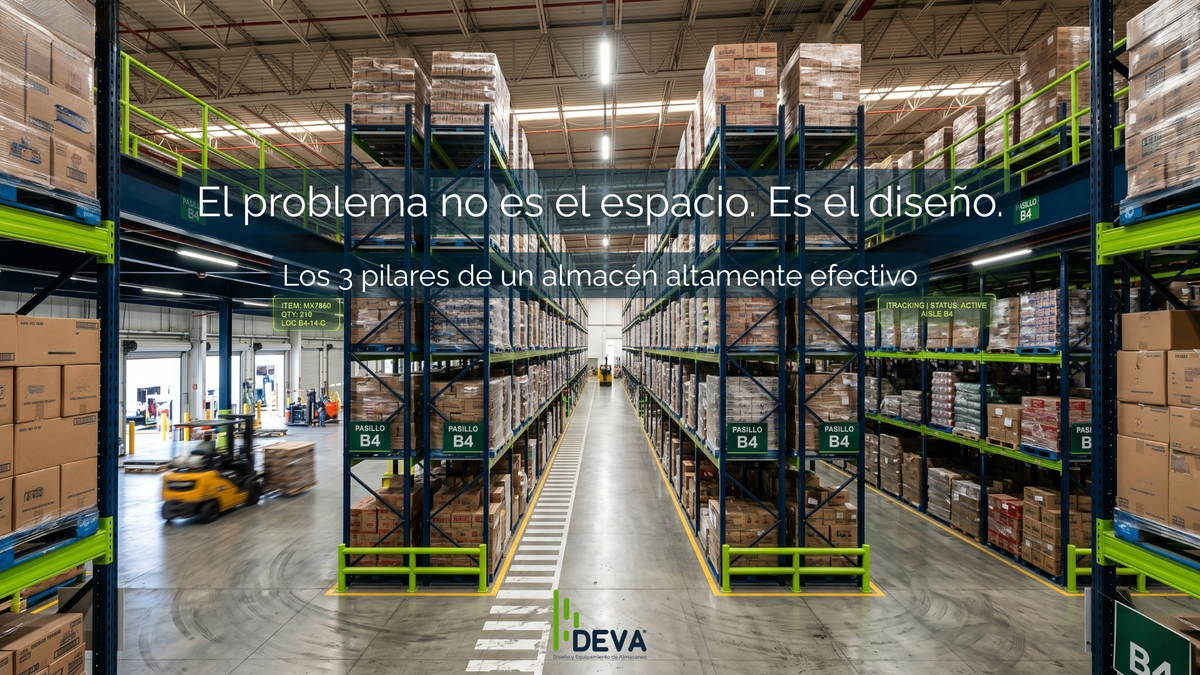
Mexico moves goods at a speed few countries in the region can match. Nearshoring is bringing new plants and supply chains to the north of the country. E-commerce grew more than 23% in recent years and keeps accelerating. And yet, inside many Mexican distribution centers, processes are still the same as a decade ago.
The pressure doesn’t come only from outside. Operations directors in Mexico today face a tough combination: rising industrial rents in corridors such as Monterrey, Guadalajara, Tijuana and the Bajío; a shortage of skilled operators; and customers (both B2B and end consumers) who no longer tolerate errors or delays. Operating the same as always is no longer a neutral option. It is a decision to fall behind.
The good news is that most of the inefficiencies bleeding the operation of a Mexican distribution center stem from the same three underlying problems. And all three have concrete solutions, without having to reinvent the warehouse from scratch.
Pillar 1: Material flow, the heart of the distribution center
Material flow is the route the product follows from the moment it enters the warehouse until it leaves for the customer. It seems basic, but when that flow was not designed with intent, and instead grew as the operation grew, it becomes the main source of lost time and invisible cost.
An efficient warehouse is not the tidiest one, it is the one that moves product with the least possible effort.
In Mexico it is very common to find distribution centers that started out as small warehouses and grew organically: a zone was added here, receiving was moved over there, picking was set up wherever there was room. The result is a layout nobody really designed, and that today creates crossing traffic, congestion at peak hours and travel paths twice as long as necessary.
Imagine a grocery distribution center in the State of Mexico, dispatching to convenience stores and wholesalers. If the picking zone is at the opposite end from the dispatch area, every completed order involves an unnecessary trip of 70 or 80 meters. With 600 orders a day, you are piling up almost 50 kilometers of travel that adds no value to the business. Redesigning the layout based on the real flow can eliminate more than 30% of those movements without changing a single process.
Another critical point is the synchronization between receiving, replenishment and picking. In high-demand seasons (Buen Fin, Christmas, back to school) this synchronization frequently breaks down: picking stops because there is no product in the position, or receiving collapses because no slots have been freed up in the racking. This is not solved with more people; it is solved with visibility and operational planning.
Applying principles such as FIFO or FEFO systematically also makes a real difference, especially in industries such as food, pharmaceuticals or personal care, where expiration control is a regulatory and economic risk. The key is for the layout to make it happen naturally, without depending on each operator’s memory or judgment.
Pillar 2: Space optimization, more capacity without changing warehouses
The cost of industrial square meters in Mexico keeps climbing. In corridors such as Apodaca, El Salto, Silao or Cuautitlán, rents have risen significantly over the last three years, driven in part by nearshoring demand. In that context, wasting space inside the distribution center is literally throwing money away every month.
And yet most Mexican warehouses are wasting between 20% and 35% of their real capacity. Not for lack of product, but because of how they are organized.
The first problem is floor use. Aisles wider than the handling equipment requires, zones of slow-moving product nobody has written off, receiving or staging areas that grew without control. Matching aisle width to the forklift or pallet jack that actually operates in that distribution center can free up rack positions without any additional investment.
The second problem is height. Most industrial buildings in Mexico have between 7 and 10 meters of clear height. But it is common to see warehouses that only use the first 3 or 4 meters, while the upper meters sit empty. Adding taller racking with the right equipment can double storage capacity without increasing the building footprint.
Dynamic slotting is one of the most powerful (and least used) tools in Mexican distribution centers. It consists of assigning locations according to each product’s real turnover, not historical categories. High-turnover items (class A) should be in the most accessible positions, closest to dispatch. Low-turnover items (class C) go in high-level or less accessible zones. Reviewing this slotting every quarter can reduce picking times by between 15% and 25%.
A representative case: a construction materials distributor in Guadalajara with more than 6,000 SKUs in active use moved from fixed storage to dynamic storage based on ABC turnover. In four months, the average time per picking line fell by almost 30%, without adding staff or expensive technology. The only change was knowing where to put each thing, and why.
The relationship between density and accessibility is also worth reviewing. Not every SKU needs to be individually accessible at all times. For high-quantity, low-variety inventories (as in the automotive, beverage or industrial supplies sectors) compact systems such as drive-in or pallet flow racking can increase storage density by between 40% and 80% compared with conventional selective racking.
Pillar 3: Applied technology, intelligence that boosts what you already have
When technology in warehouses comes up, many operations directors in Mexico think of long, expensive projects that are hard to implement. That perception is changing, and with good reason: most of the technology improvements that truly transform a distribution center are not heavy automation. They are tools that give visibility and control to the team you already have.
The most impactful change for a mid-sized warehouse in Mexico is implementing a WMS suited to its size and real operation.
A well-configured WMS eliminates dependence on paper, on Excel and on the warehouse clerk’s memory. It tells each operator what to take, where it is, in what quantity and where to bring it. It records every movement, updates inventory in real time and generates alerts when something deviates from the plan. The result is concrete: fewer picking errors, less shrinkage, fewer customer complaints and inventory accuracy that can go from 85% to 98% in a few months.
You don’t need the most robust WMS on the market to get started. There are solutions that can be implemented in weeks, integrate with the most common ERPs in Mexico and adapt to operations with 3,000 or 80,000 SKUs. The selection criterion should not be the lowest price or the best-known name, but the best fit with the real processes of your operation.
Beyond the WMS, there are low-cost technologies with a high return. Wireless barcode scanners, label printing at the packing station and pick-by-light or pick-by-voice systems reduce picking errors by between 60% and 85% compared with manual processes. They are tools available today, with local suppliers in Mexico, and with payback periods usually measured in months, not years.
Real-time data is the new baseline for a competitive distribution center. It is not about technology for its own sake. It is about being able to answer concrete questions: what is my inventory accuracy today? Which SKUs generate the most picking errors? In which shift is rework concentrated? With that information available on an up-to-date dashboard, operating decisions stop being based on intuition and start being based on evidence.
IoT is also starting to have very practical applications in Mexican warehouses: temperature sensors for cold rooms in the food industry, condition monitoring in pharmaceutical warehouses under COFEPRIS regulations, access control in high-value zones. Small connected devices replace constant manual inspections and reduce the risk of regulatory non-compliance.
Three pillars, one system
Material flow, space optimization and applied technology are not independent initiatives: they reinforce each other. A well-designed layout makes slotting work better. Smart slotting makes the WMS more efficient. And a WMS with real-time data lets you keep adjusting flow and space based on what actually happens in your operation, week after week.
Transforming a Mexican distribution center does not always require starting from scratch or stopping the operation. In most cases, reviewing these three pillars with a technical eye and without historical bias is enough to find opportunities that deliver results in weeks.
At DEVA we help companies in Mexico diagnose, design and equip warehouses that operate with intent. If you are evaluating how to improve the efficiency of your distribution center, whether because your operation is growing, because of nearshoring pressure or simply because you know there is more potential than you are tapping today, we will gladly schedule a conversation.
Which of these three pillars would you start with in your operation?
Ready to optimize your warehouse?
Talk with a DEVA expert and get a free personalized warehouse assessment.