
Warehouse Slotting: The SKU Positioning Strategy Nobody Taught You (But Your Operation Needs)
What is slotting, and why does nobody teach it well?
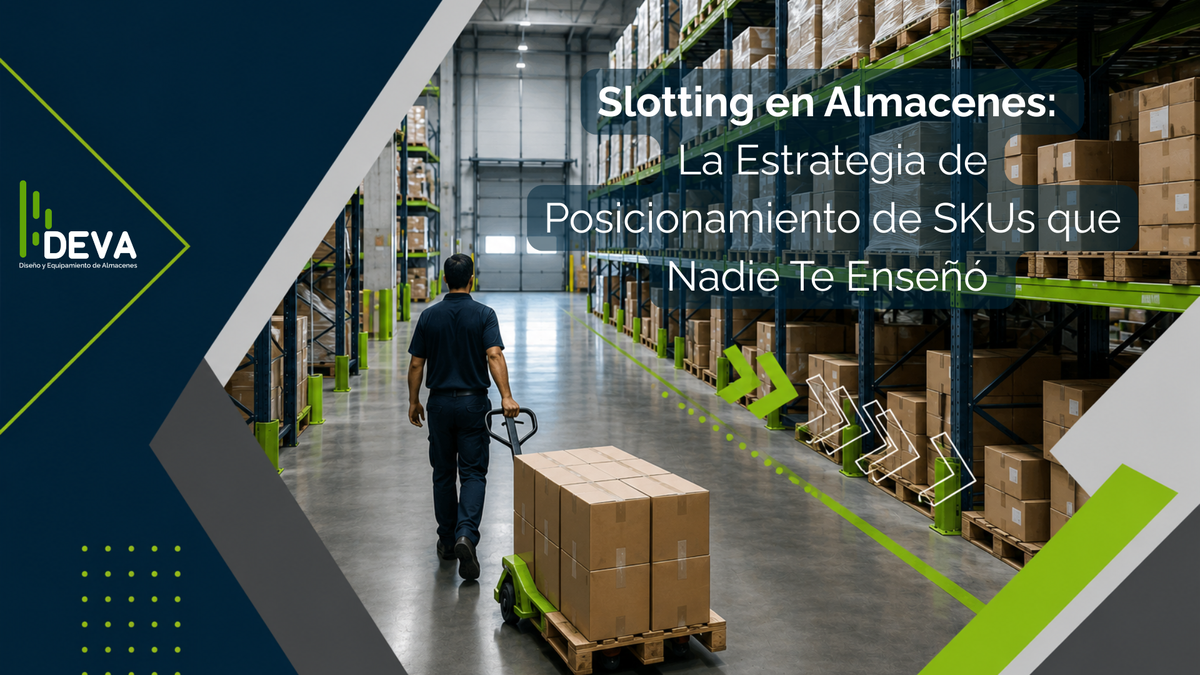
Slotting is the discipline of assigning each SKU to the most suitable location within the warehouse, considering variables such as turnover, size, weight, outbound frequency, compatibility, order volume and ergonomics.
Put simply: not every product deserves just any location.
A SKU that ships 200 times a week should not be in a zone that is far away, high up, awkward or hard to reach. A heavy product should not force the operator to lift it from an upper position. An item that is almost always sold together with another should not be three aisles away.
The problem is that many companies keep assigning locations with inherited criteria: “that’s how we set it up from the start”, “it fits there”, “that aisle has always belonged to that product family” or “when goods arrive, we put them wherever there’s space”.
That is not slotting. That is space occupation.
And that is where the hidden cost begins.
Slotting isn’t taught well because it usually seems like a minor topic next to more visible decisions: buying racking, implementing a WMS, automating, expanding the distribution center or hiring more staff. But before investing more, it is worth asking a basic question:
Are we making good use of the locations we already have?
Many mid-sized operations believe slotting is only for giant warehouses, with thousands of positions and advanced software. That is not true. A distribution center with 500 SKUs can already have serious slotting problems. An operation with 5 pickers can already waste hundreds of hours a year on poorly designed travel paths.
Slotting doesn’t start with technology. It starts with operational judgment.
The 3 critical variables of slotting
SKU turnover: not every product should live in the same zone
The first variable is the best known, but also one of the worst applied: turnover.
ABC analysis classifies SKUs according to their operational importance. Normally, A products represent a small percentage of the catalog, but concentrate a large share of the movement. B products have medium turnover. C products move little, but take up space and consume attention if they are poorly located.
The logic of slotting is clear: A products should be in the most accessible picking zones, close to dispatch, with the least search effort and the shortest travel distance.
Not because they are “more important” in commercial terms, but because they are touched more often.
If a SKU is picked 80 times a day, every extra meter to its location is multiplied by 80 trips. If that same mistake happens with 50 SKUs that move fast, the impact stops being small and becomes a daily productivity leak.
This is where many operations make a mistake: they arrange stock by commercial family, supplier or product type, but not by real outbound frequency.
Visual order does not always mean operational efficiency.
A warehouse can look clean, symmetrical and orderly, yet be forcing the picker to walk too much. Slotting does not aim for the layout to “look nice”. It aims for movement to make sense.
Picking distances: every extra step has a calculable cost
The second variable is distance. And here it pays to be very direct: every unnecessary step is an operating cost.
Let’s assume something simple: one additional step takes approximately 1 second between travel, turning, visual search and micro-interruptions. If that second is repeated across 500 picks a day, we are talking about 500 seconds a day, that is, just over 8 minutes daily.
It may not sound like much.
But if we take it to 240 operating days a year, that comes to 2,000 minutes, or more than 33 labor hours wasted on a single poorly designed second in the process.
Now imagine it isn’t one second. It’s 10, 20 or 30 additional seconds per pick due to long travel paths, poorly grouped locations, congested aisles or fast-moving SKUs located far from the dispatch zone.
The problem is no longer minor. It is structural.
Picking is usually one of the most labor-intensive activities in the warehouse. If the operator spends more time walking than picking product, the layout is charging a daily bill.
And that bill is not always fixed by hiring more staff. Sometimes it is fixed by placing SKUs better.
Compatibility and ergonomics: it’s not just about selling more, but about picking better
The third variable is compatibility. Two key dimensions come into play here: physical compatibility and operational compatibility.
Physical compatibility answers questions such as:
Is the product heavy? Is it fragile? Is it bulky? Does it require special handling? Should it be kept away from other products for reasons of safety, food safety or contamination risk?
The basic rule seems obvious, but it is frequently broken: heavy products low, light products high. High-handling products in ergonomic zones. Fragile products in locations that reduce impacts, unnecessary maneuvers or double handling.
Operational compatibility has to do with order correlation. In other words: products that tend to be sold together should be close to each other.
If SKU A and SKU B appear together in a large number of orders, separating them generates unnecessary travel. The warehouse should reflect the real behavior of demand, not just the structure of the catalog.
This is where slotting starts to become very powerful: it doesn’t just arrange products by individual turnover, but by picking logic.
Because the picker doesn’t walk by SKU. They walk by order.
Step by step: how to do slotting tomorrow without investing a single peso
Slotting doesn’t have to start with expensive software. It can begin with a manual, disciplined and very practical review.
The first step is to build a simple turnover vs. distance matrix. You don’t need an advanced system to spot the first opportunities. You can start with sales data, picked orders, movements per SKU or picking frequency.
The initial question is direct:
Which SKUs are touched the most, and where are they located?
From there, cross-reference three basic pieces of data:
- Outbound frequency.
- Distance from the dispatch or consolidation zone.
- Difficulty of access to the location.
With that you can spot very clear contradictions. For example: A SKUs located at the back, low-turnover products occupying premium zones, heavy items on high levels or SKUs that tend to be sold together separated by several aisles.
A practical rule: the fastest 20% of SKUs should occupy approximately 50% of the most productive locations.
It does not mean giving them more space on a whim. It means assigning them better locations because they generate a greater number of movements. The most accessible space should be reserved for what has the most impact on the daily operation.
Practical checklist for starting a manual slotting project:
- Identify your A, B and C SKUs with data from the last 3 to 6 months.
- Mark the zones closest to dispatch, packing or consolidation on a simple floor plan.
- Calculate which fast-moving SKUs are far from those zones.
- Relocate the A products with the highest picking frequency first.
- Place heavy products on low levels and in easy-access zones.
- Group products that appear together in recurring orders.
- Free up premium locations occupied by slow SKUs or dead inventory.
- Check whether the new location reduces travel, congestion or errors.
- Document the changes so the arrangement does not slip back into the old disorder.
- Repeat the analysis every 3 to 6 months, because demand changes.
This last point is key: slotting is not a one-time project.
Products change. Promotions change. Seasonal demand changes. Customers change. Sales channels change.
If your picking layout isn’t updated, sooner or later it stops reflecting the reality of the operation.
A good exercise is a quarterly review of your A SKUs. You don’t need to move the whole warehouse. Sometimes, by relocating 30, 50 or 100 SKUs, the critical ones, you can reduce travel, speed up picking and improve the operator’s experience.
The goal is not to redesign for the sake of redesigning. The goal is to move the minimum necessary to generate the maximum impact.
If your operation suspects it is walking more than necessary, DEVA can help you diagnose the current slotting of your warehouse and turn the location of your SKUs into a measurable operational advantage.
Ready to optimize your warehouse?
Talk with a DEVA expert and get a free personalized warehouse assessment.