
Garment-on-hanger rail system: manual or automated
The garment-on-hanger rail system transports and stores garments hanging on their hangers, sliding them along a rail instead of folding them or packing them in boxes. It is the technology the textile industry uses to move large volumes of garments without wrinkling them, from the production line to shipping. At DEVA, we implement it in both its manual and its automated version, depending on the volume and budget of each operation.
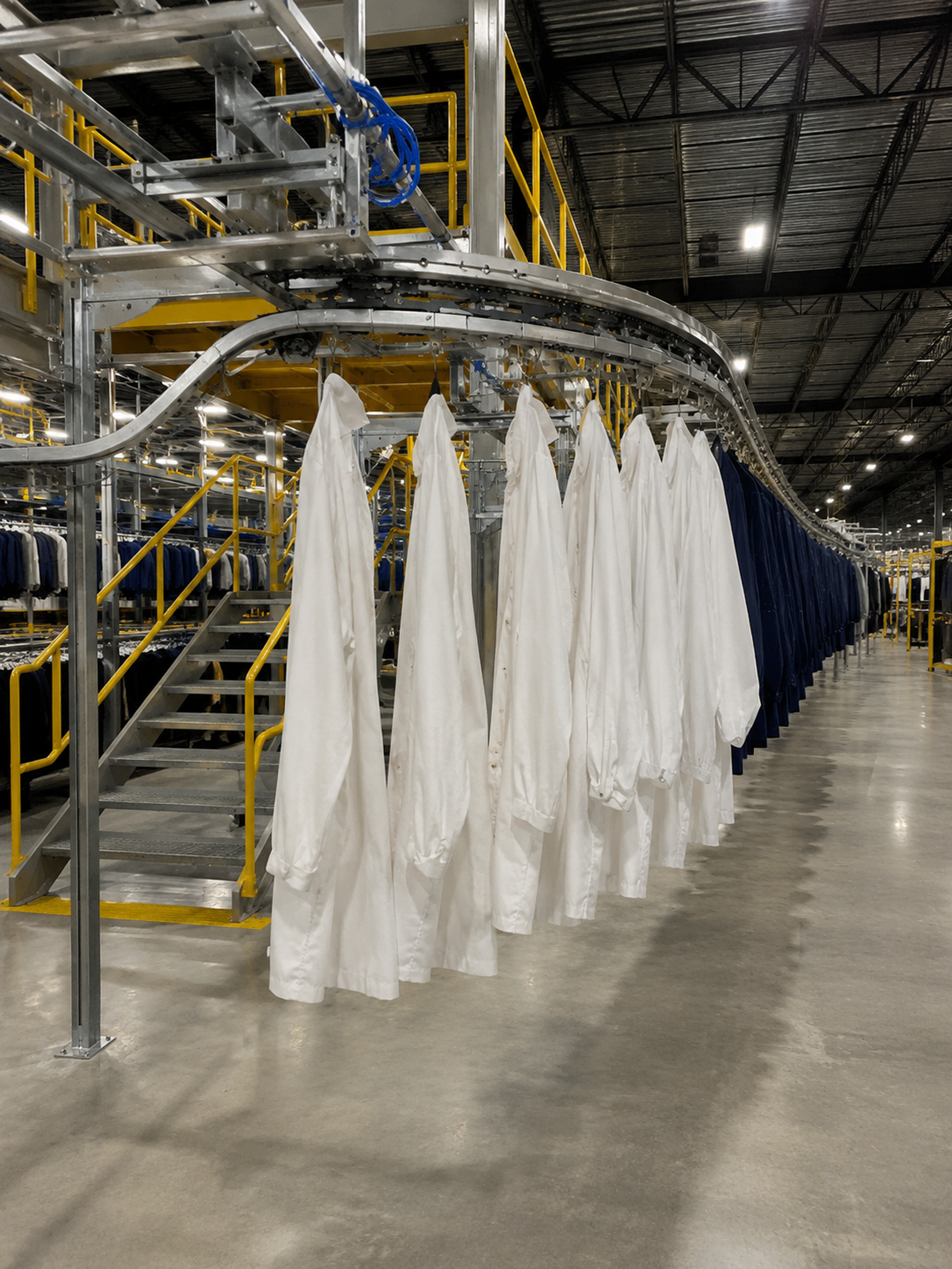
How does it work?
The heart of the system is a rail (fixed to the ceiling or to a support structure) along which garments travel on their hangers, either directly or on a small trolley that hooks onto the rail. In the manual version, the operator pushes the garment along the rail; in the automated version, an overhead conveyor moves the garments continuously, without manual intervention.
Two solution levels
Manual (direct-slide rail): garments are hung on their hangers and moved by pushing them by hand along the rail, with no need for trolleys or motors. It is the lowest-investment option, ideal for storage buffers, truck loading and unloading areas, or short transfers between workstations.
Automated (overhead conveyor): motors move the garments continuously and without manual intervention, with lifts to raise or lower them between levels and loading and unloading points configured to suit the operation. It can feed or offload finishing machinery directly (such as steam tunnels, bagging machines or hanger-loading machines) and sort garments by destination.
System components
Rail or suspended track, fixed to the ceiling or to a support structure.
Hanger or trolley that slides along or hooks onto the rail to carry the garment.
In the automated version: motors and drive system, lifts for level changes, and automatic sorting points.
How does it work with other solutions?
The garment-on-hanger rail system rarely covers the entire operation on its own:
Coexists with picking shelving/Menorack for goods handled folded or boxed within the same distribution center.
Integrates with mezzanine floors and multilevel structures, using lifts to move garments between floors.
Can feed textile finishing machinery (pressing, bagging, hanger loading) when the operation requires it.
The same rail system can carry the garment from production to shipping, with no need to take it off its hanger at each stage.
Benefits · Impact on your operation
It keeps garments free of wrinkles and creases, eliminates unnecessary handling (there is no need to take them off the hanger and rehang them at each stage), reduces transfer times within the distribution center, and adapts to each operation's budget, since you can start with the manual version and scale up to automated as volume grows.
Ideal applications
Fashion brands and distributors with a high volume of garments on hangers, operations that need to move clothing between production, warehouse and shipping without taking it off the hanger, and textile distribution centers looking to reduce pressing and handling times before the point of sale.
Frequently asked questions
- What is a garment-on-hanger rail system?
- It is a transport and storage system in which garments travel hanging on their hangers along a rail, instead of being folded or packed in boxes.
- Is there a manual version, without motors?
- Yes. The manual version uses a direct-slide rail where the operator pushes the garment by hand, with no trolleys or motors; it is the lowest-investment option.
- Can it be combined with shelving for boxed goods?
- Yes. It is common for the same distribution center to use the rail system for hanging garments and picking shelving/Menorack for goods handled folded or boxed.
- Can the automated system sort garments?
- Yes. The automated version can include sorting points to direct each garment to its destination within the distribution center.
Ready to optimize your warehouse?
Talk with a DEVA expert and get a free personalized warehouse assessment.