Carton Flow: dynamic case picking with FIFO rotation
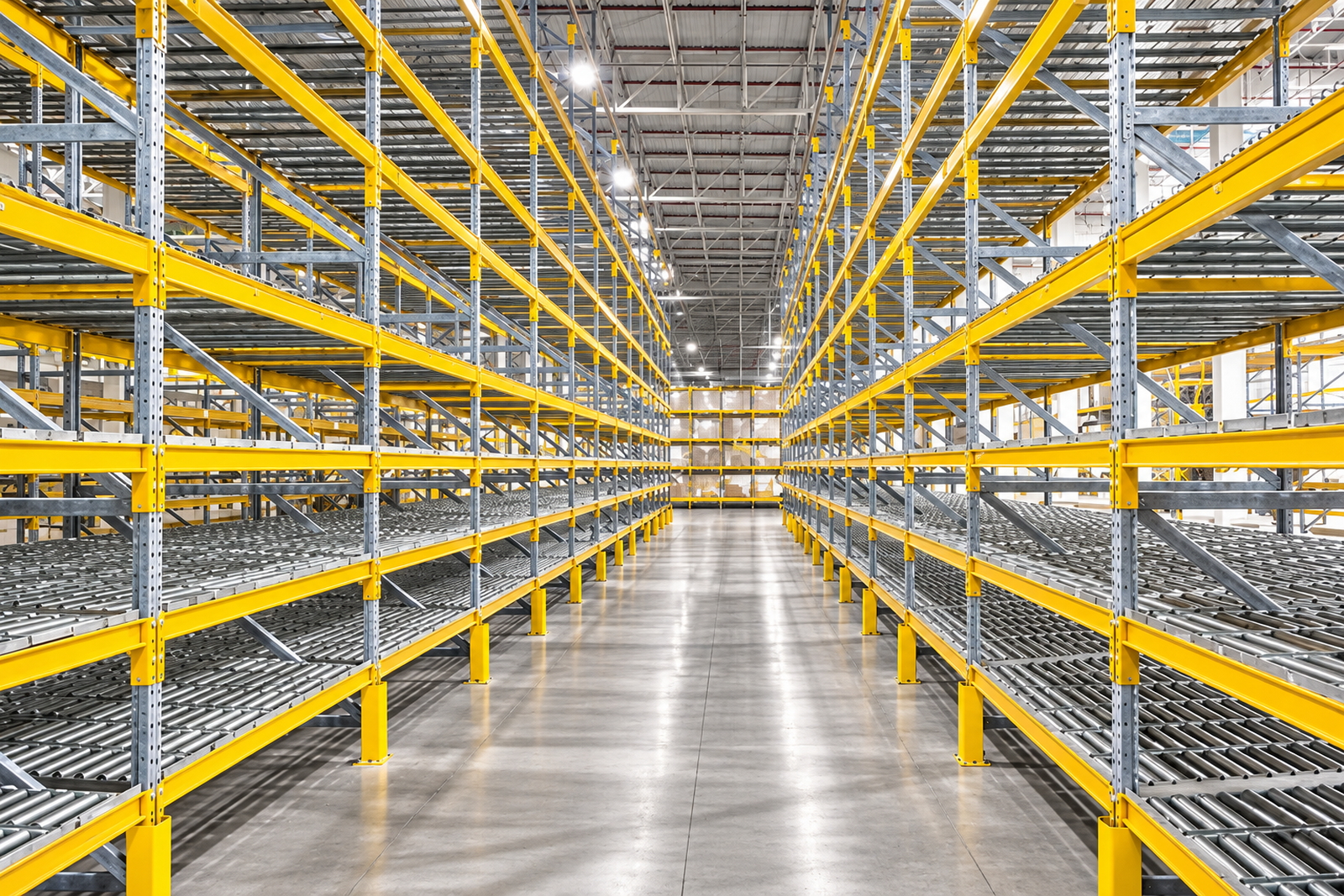
Carton Flow (also called dynamic case picking) is a storage system for cases and loose units in which each level has an inclined bed of wheels or rollers: the operator replenishes from the rear and the case slides by gravity to the front of the lane, where picking takes place. It is the equivalent of dynamic racking (Pallet Flow), but at case scale instead of pallet scale: the goods are always in the first position, and the operator never has to reach into the lane to find them.
How does a Carton Flow system work?
Each level of the system is a slightly sloped lane fitted with wheels or rollers. The operation physically separates two flows:
Loading from the replenishment aisle (rear of the lane): new cases are fed in.
Gravity feed: the cases move forward on their own as the ones ahead are removed.
Picking from the order picking aisle (front): the operator always takes the oldest case, which is already in position.
With loading and picking in separate aisles, replenishment never interrupts order picking.
Why does Carton Flow produce automatic FIFO rotation?
Because the outbound order is set by the geometry of the lane, not by the operator's judgment: the first case in is the first to reach the front and, therefore, the first out (FIFO). That automatic rotation is the basis for working under FEFO (first expired, first out) in food, beverages, pharma and any product with an expiration date.
Key features
Gravity flow: no motors and no energy consumption; the slope of the lane does the work.
Wheel or roller beds: chosen according to the weight, the base and the type of packaging of the case.
Separate replenishment and picking: two independent aisles, zero interference between operators.
Compact picking face: many SKUs available in just a few linear meters of aisle.
FIFO rotation guaranteed by design: it does not depend on operator discipline.
Combinable: it fits in as the lower level of selective racking, a picking tower or a platform floor, with pallet reserve storage above.
Carton Flow vs. pallet flow racking vs. picking shelving: which do I need?
| System | Unit handled | Flow | When to choose it |
|---|---|---|---|
| Carton Flow/dynamic case picking | Case or loose unit | Gravity, FIFO | Intensive picking of many SKUs with constant replenishment |
| Dynamic racking (Pallet Flow) | Full pallet | Gravity, FIFO | High turnover of pallets of homogeneous product |
| Picking shelving/Menorack | Case, item, spare part | Static, direct access | Low or medium turnover, with no need for continuous replenishment |
Benefits · Impact on your operation
It shortens picker travel by concentrating more SKUs in less aisle, eliminates idle time caused by replenishment during picking, ensures inventory turnover without manual control and reduces shrinkage from product that expires or gets left behind at the back of the level.
Ideal applications
Distribution centers with case or piece picking and a wide variety of SKUs: food and beverages, consumer goods, pharma, e-commerce, spare parts distributors and 3PL logistics providers with multi-client order picking.
Frequently asked questions
- What is a Carton Flow system?
- It is a storage system for cases and loose units with inclined lanes of wheels or rollers, where goods are replenished from the rear and move forward on their own by gravity to the front of the lane for picking, producing automatic FIFO rotation.
- What is the difference between Carton Flow and dynamic racking (Pallet Flow)?
- It is the same gravity principle applied to different units: dynamic racking moves full pallets; Carton Flow moves cases and picking units.
- Does Carton Flow need electrical power?
- No. The case moves by gravity alone, thanks to the slope of the lane, so the system requires no motors and consumes no electricity.
- Can it be combined with other storage systems?
- Yes. It is commonly installed on the lower levels of selective racking, a picking tower or a platform floor, leaving pallet reserve storage on the upper levels.
- Is it suitable for expiration date control?
- Yes. Because it enforces FIFO outflow by design, it is one of the most reliable foundations for working under FEFO (first expired, first out).
Ready to optimize your warehouse?
Talk with a DEVA expert and get a free personalized warehouse assessment.