
Semi-automatic Pallet Shuttle: compact storage with a shuttle cart
The semi-automatic Pallet Shuttle is a compact storage system in which a motorized cart travels on rails inside the racking lane to place and retrieve pallets. The forklift no longer enters the lane: it sets the cart and the pallet at the head of the lane, and from there on the cart handles all movement in depth. The result is a structure that makes the most of its depth, accepts a different SKU in each lane and keeps the maneuver that causes impacts outside the structure.
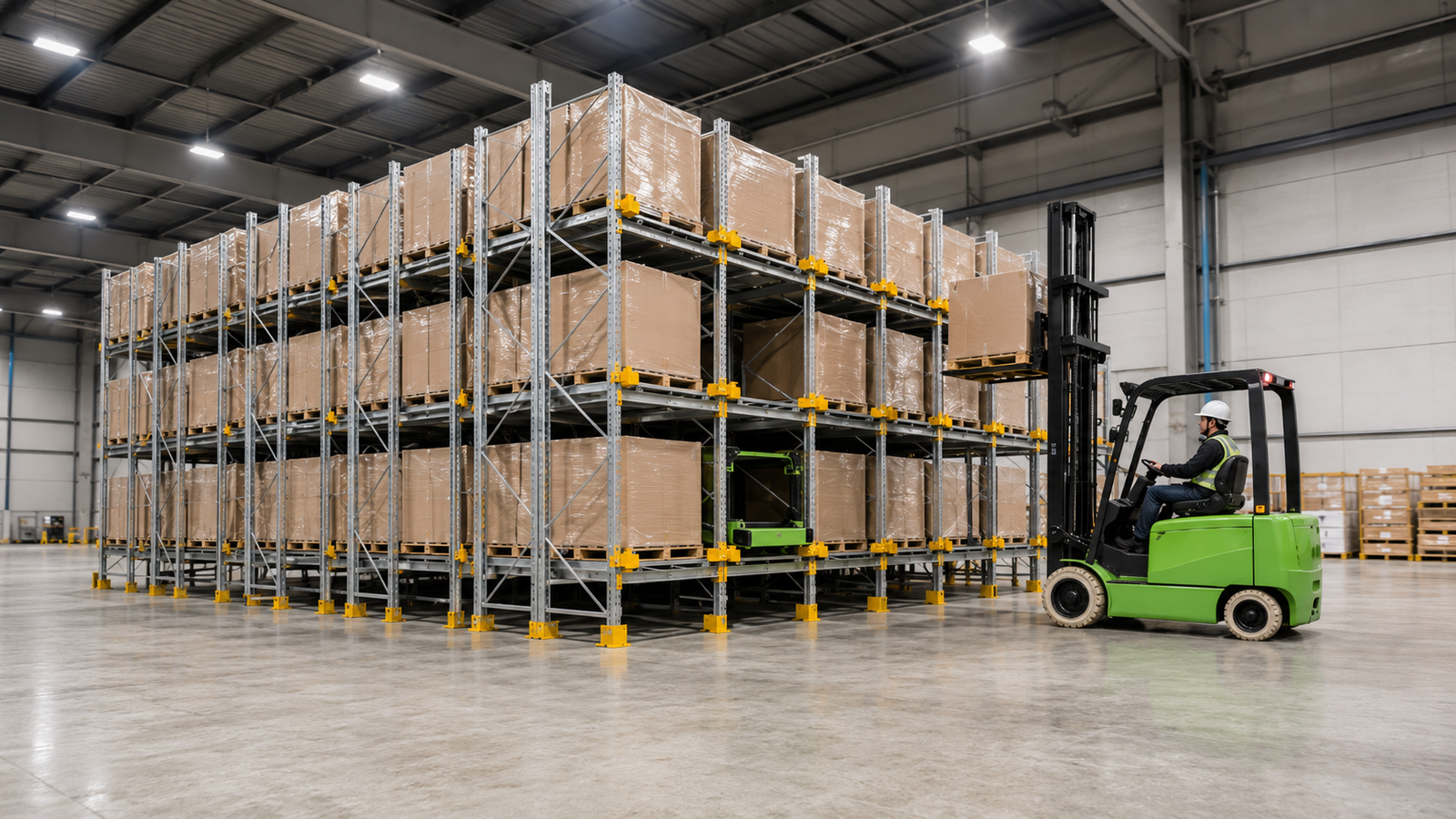
How does the semi-automatic Pallet Shuttle work?
The operator places the shuttle cart on the rails with the forklift's forks, sets the pallet on top and sends the command from a tablet or remote control. The cart lifts the pallet slightly, carries it to the last free position in depth and returns to the head of the lane for the next one. To retrieve, the sequence is reversed. When another lane needs to be worked, the forklift picks up the cart and repositions it, and that repositioning, not the cart's speed, is what sets the real pace of the operation.
How is inventory managed?
The lane is the system's management unit and is handled as a single logical position: you know how many pallets it holds and how far back they reach, but there is no individual record by depth. This leads to three design rules worth settling from the project stage:
One SKU per lane. Products are not mixed within the same lane.
LIFO by default. Loading and unloading happen at the same end, which works well with homogeneous products that have a long shelf life.
FIFO with double access. It requires entry at one end and exit at the other, meaning two working aisles defined from the layout stage. A single lane cannot combine both criteria.
System components
Motorized shuttle cart with a controller, lithium battery, positioning and load-detection sensors, and an obstacle stop.
Compact racking structure: frames, beams and support rails designed for the cart to travel on and to support the pallet.
Control device (remote control) for loading, unloading, counting and lane inventory commands.
Safety elements: end-of-lane stops, perimeter guards, load capacity signage and anti-collapse mesh wherever there are walkways.
How does it work with other solutions?
Coexists with picking and high-variety zones within the same distribution center, covering the block of high-volume palletized product.
Integrates with the WMS to track occupancy by lane, although the cart's control is independent and does not need the WMS to operate.
Operates in cold storage and freezer rooms with a specific configuration, where compactness reduces the refrigerated volume and with it the energy cost.
Grows in stages. The installation can scale lane by lane and add carts as volume increases, without redesigning the entire block.
Requirements for your operation
A firm, level floor with calculated mechanical strength for the total load of the block. Flatness directly affects the cart's travel.
Homogeneous, well-built unit loads. Overhanging, damaged or variable-size pallets cause jams inside the lane.
A matching forklift fleet. The height of the installation is set by the equipment's lifting capacity, and the aisle width by its turning radius.
High volume per SKU. This is the criterion that determines whether the system pays off: with many SKUs and few pallets of each, the forklift ends up repositioning the cart all day.
Benefits · Impact on your operation
It multiplies capacity in depth without expanding the building, eliminates forklift entry into the structure and with it the impacts that are a fixed maintenance cost today, allows a different SKU per lane, reduces maneuvering times because the operator no longer has to enter the lane, and lowers the risk of accidents by keeping staff out of the cart's work zone.
Ideal applications
Operations with high volume per SKU and homogeneous unit loads: food and beverage, cold chain, manufacturing with palletized finished goods, and distribution centers that need to gain capacity within the same property under pressure from the cost per square meter of industrial space.
Frequently asked questions
- What is a semi-automatic Pallet Shuttle?
- It is a compact storage system in which a motorized cart travels inside the racking lane to place and retrieve pallets. It is called semi-automatic because the cart is still moved between lanes by forklift.
- Does it eliminate the use of forklifts?
- No. It takes the forklift out of the structure, which is where impacts and slow maneuvers happen, but the forklift is still essential for positioning the cart and moving the pallet between the dock and the head of the lane.
- Can I handle FIFO and LIFO in the same lane?
- No. Each lane operates under a single criterion. LIFO is the default behavior; FIFO requires access from both ends of the lane, which means two working aisles defined from the layout stage.
- How many SKUs can I store?
- As many as the installation has lanes, with one SKU per lane.
- Does it work in a freezer room?
- Yes, with a specific low-temperature configuration. It is one of the applications with the best return, because compactness reduces the refrigerated volume and with it energy consumption.
Ready to optimize your warehouse?
Talk with a DEVA expert and get a free personalized warehouse assessment.