
Push-back racking: high density with fast maneuvers
Push-back racking is a high-density system that lets you store several pallets deep on each level. The pallets sit on carts, wheels or rollers that travel on rails, so you can load and unload from the same aisle without the forklift entering the structure.
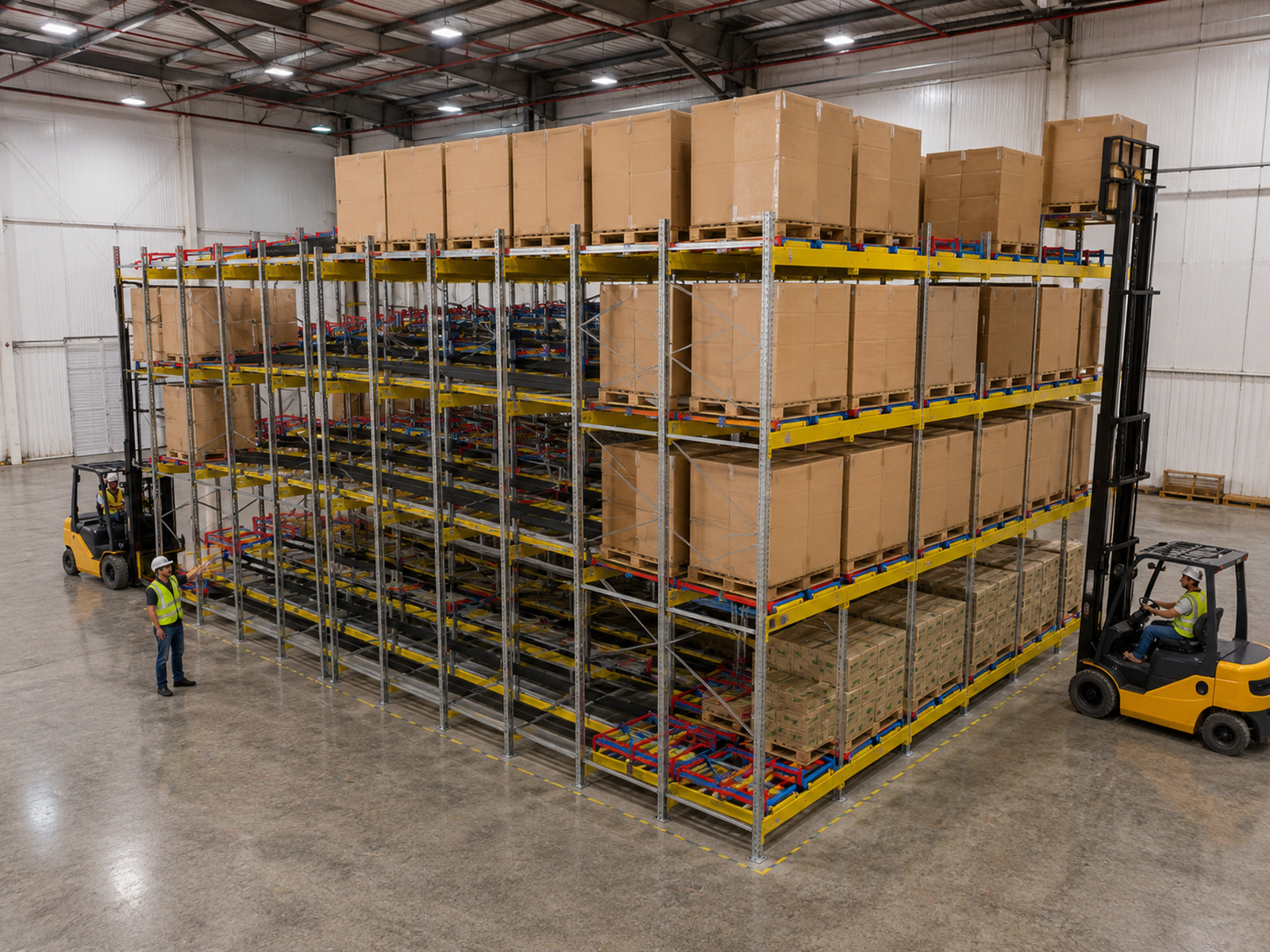
How does push-back racking work?
Each level holds several pallets on sliding carts, wheels or rollers: when a new pallet goes in, it pushes the previous ones toward the back; when it is removed, the ones behind move forward by gravity. It operates on LIFO (last in, first out).
Key features
Up to 6 pallets deep per level with the cart option, 6+ with the wheel and roller options: more capacity without expanding the warehouse.
LIFO operation: the last pallet in is the first one out.
Fast maneuvers: the forklift does not need to enter the storage lanes.
One SKU per level: greater flexibility than other compact systems.
Optimal use of space: high density with minimal loss of height.
Benefits · Impact on your operation
More storage positions, less wasted space, better forklift productivity and a higher return per available cubic meter.
Ideal applications
Medium-turnover operations with several pallets per SKU that want density without giving up the flexibility of a different SKU on each level.
Frequently asked questions
- How many pallets does push-back racking hold?
- Up to 6 pallets deep per level with the cart option, 6+ depending on the configuration, operating on the LIFO system.
- Does the forklift drive into push-back racking?
- No. Loading and unloading are done from the same aisle thanks to the carts on rails, which speeds up maneuvers.
Ready to optimize your warehouse?
Talk with a DEVA expert and get a free personalized warehouse assessment.