
Slotted angle shelving: modular storage for light loads
Slotted angle shelving is a storage system for light loads built from steel angle posts perforated along their entire height and assembled with bolts. Those continuous slots let you place each shelf at the height the product requires and reconfigure the entire shelving unit when your operation changes. It is the most economical and versatile solution for organizing spare parts, boxes, tools, supplies and files in storerooms, workshops and service warehouses.
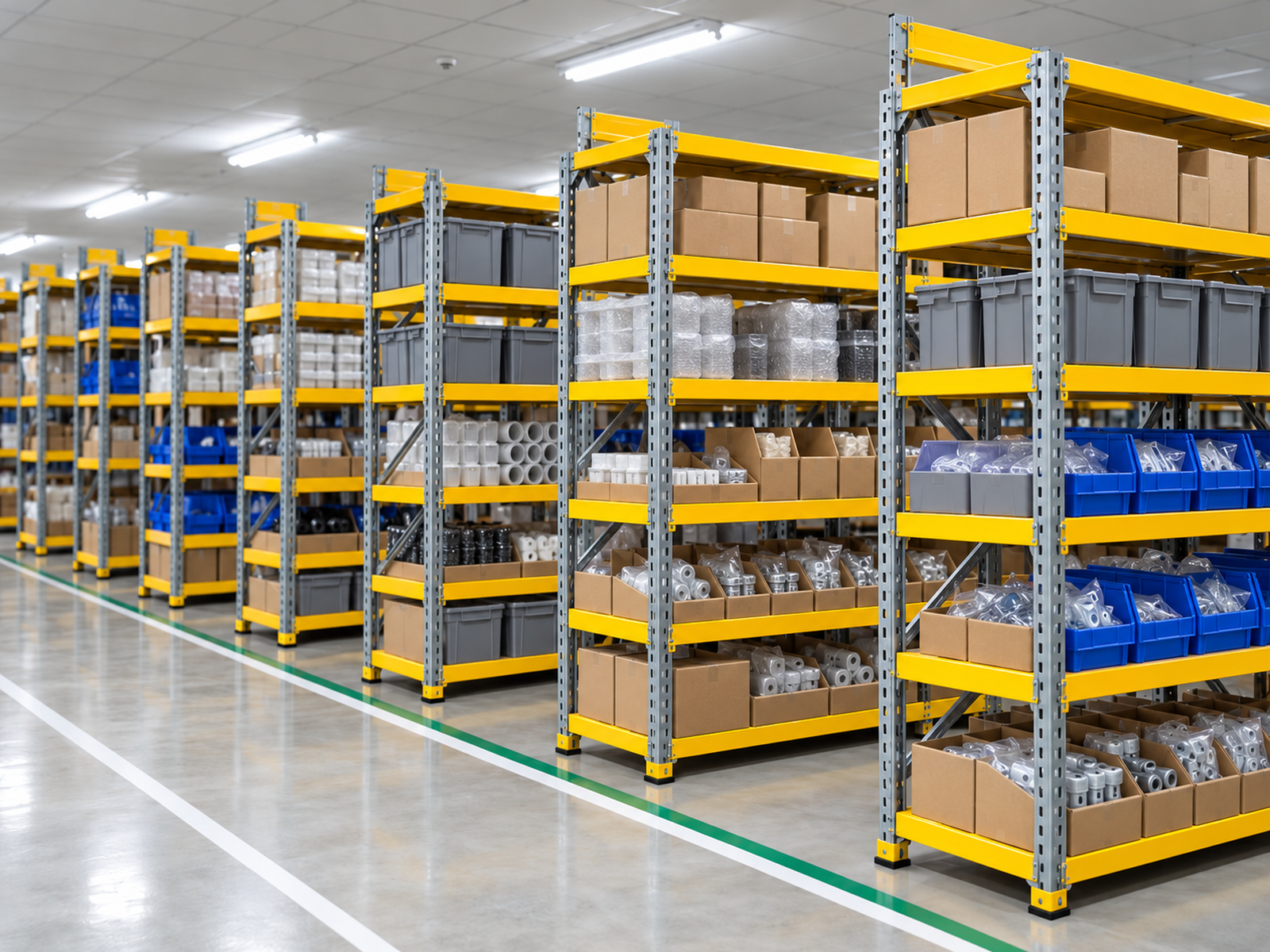
What is slotted angle shelving?
It is modular steel shelving whose defining element is the slotted angle post: an "L" profile with a series of perforations that act as anchor points. The shelves (sheet steel, wire mesh or wood) are bolted at the desired height. Unlike pallet racking, it is designed for 100% manual operation, with no forklift.
How is it assembled and reconfigured?
The system is assembled by bolting the shelves to the posts at the corresponding slot, so it requires no welding or specialized equipment: it can be assembled, disassembled, expanded or relocated with basic tools. The same logic lets you turn two short units into one taller unit, change the spacing between levels when the product packaging changes, or move the shelving to another area of the warehouse without losing any material.
Key features
Fully adjustable levels: the continuous slotting of the post lets you set the height of each shelf.
Bolted assembly: no welding, basic tools only; it can also be disassembled and relocated.
Modular and expandable: it grows in height or with additional units as your inventory grows.
Manual operation: direct access to the product, with no forklift or handling equipment.
Shelf options: sheet steel, wire mesh or wood, depending on the type of load and the visibility required.
Low cost per position: the lowest-investment option within the storage systems family.
Slotted angle or picking shelving/Menorack?
Both are light-load, manual-operation solutions, and they work well side by side in the same warehouse. The difference lies in the profile of the operation:
| Slotted angle | Picking shelving/Menorack | |
|---|---|---|
| Assembly | Bolted, piece by piece | Modular clip-in design, faster installation |
| Best for | Safekeeping, organization and occasional access | Frequent order picking |
| Strong point | Flexibility and cost | Picking productivity |
| Typical use | Spare parts, tools, supplies, files | Picking areas in distribution centers |
Benefits · Impact on your operation
It organizes low-volume inventory and makes it visible, recovers square meters by using the available height with no investment in handling equipment, reduces search times for spare parts and supplies, and adapts to product changes without replacing the structure.
Ideal applications
Service storerooms and warehouses, workshops and maintenance areas, spare parts stores, supply and packaging warehouses, document archives, retail stores and stockrooms.
Frequently asked questions
- What is slotted angle shelving?
- It is steel shelving for light loads made of steel angle posts with continuous slots, to which the shelves are bolted at the height each product requires.
- Why is it called "slotted angle"?
- Because of its post: an angle-shaped steel profile ("L") perforated with a series of slots along its entire length, which are the points where the shelves are fastened.
- Can the shelf heights be changed after installation?
- Yes. Because the shelves are bolted onto a continuous slot, levels can be repositioned, added or removed with basic tools, without cutting or welding.
- How much weight can it hold?
- It depends on the gauge of the post, the type of shelf and the spacing between levels; it is a light- to medium-duty system, not for pallets. DEVA sizes the configuration to the actual weight of your product.
- Do I need a forklift to operate it?
- No. It is a system for 100% manual operation, with direct operator access to every level.
Ready to optimize your warehouse?
Talk with a DEVA expert and get a free personalized warehouse assessment.