Warehouse signage: order, safety and traceability
A warehouse with clear signage runs faster and with fewer risks. Signage is not an aesthetic detail: it defines where people and forklifts travel, lets you locate any product in seconds and communicates the load limits that protect your structure. At DEVA, we design and implement complete signage for warehouses and distribution centers, aligned with the applicable Mexican regulations.
What does the signage service include?
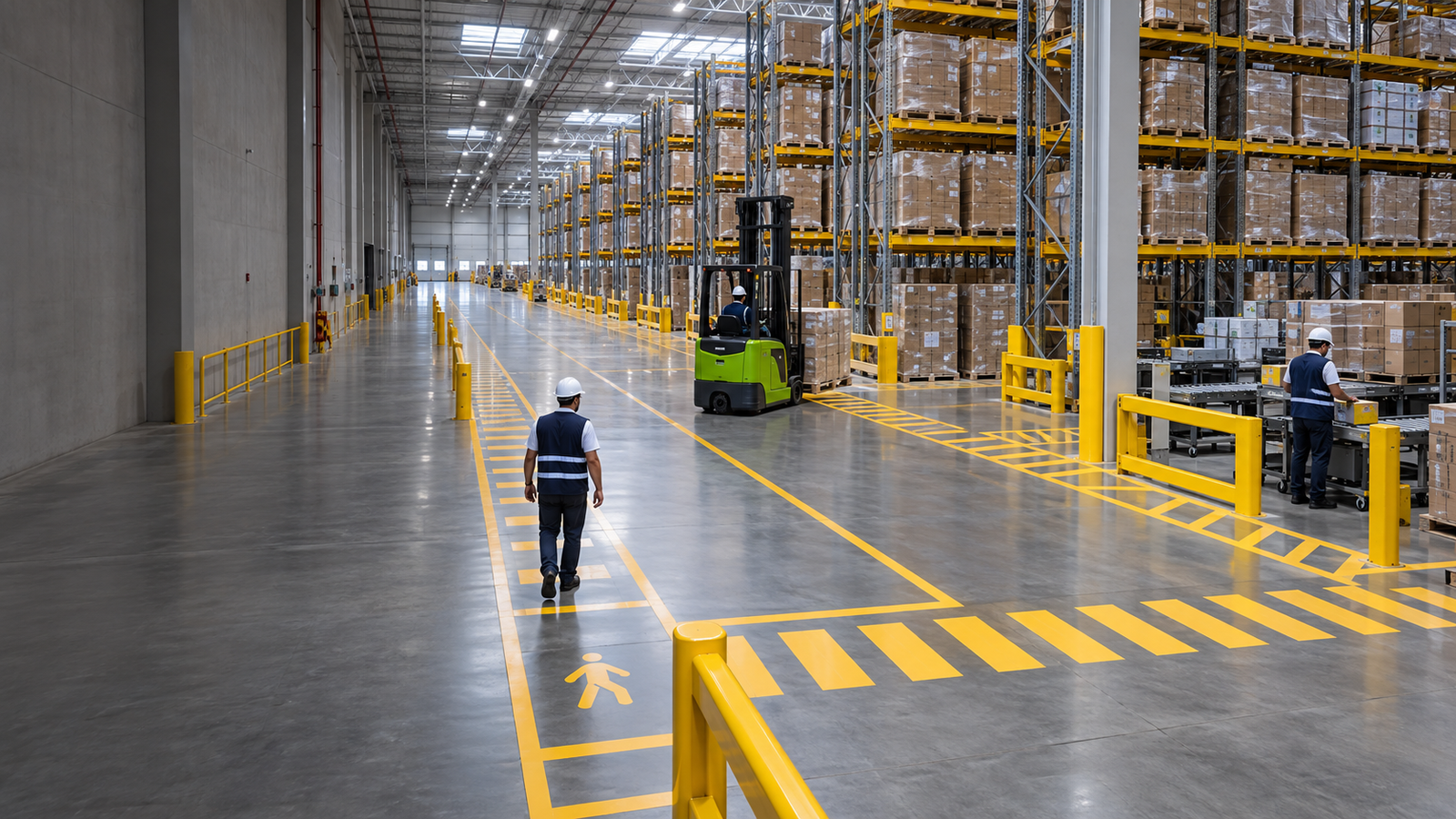
1. Floor signage
Marking of traffic aisles, pedestrian walkways, loading and unloading areas and stacking zones with paint or industrial tape. It physically separates forklift flow from people flow, which is where the most serious incidents in a warehouse occur.
2. Location identification
Rack labels, barcodes for each position, aisle signs and definition of the location naming convention. It is the foundation your inventory runs on: without a logical, legible naming convention, no management system can direct the operator correctly.
3. Safety signage
Evacuation routes, fire extinguisher locations, civil protection signage and regulatory signs, following the colors and shapes established by NOM-026-STPS-2008 (safety and hygiene colors and signs).
4. Load capacity plaques on racking
Notices showing the maximum allowable load per level and the maximum number of products, containers or boxes that can be stacked. It is an express requirement of NOM-006-STPS-2023 and one of the first things an inspector checks.
Location identification: the foundation of your WMS
Of the four components, the one with the greatest operational impact is location identification. A warehouse management system (WMS) directs the operator to a specific position (aisle, bay, level, depth), but that instruction only works if the physical location is labeled clearly, legibly from the working distance and consistently with the naming convention loaded in the system.
That is why we design the naming convention together with your operation: we define the numbering logic, the height and size of the labels according to the reading distance, and the type of code (linear or 2D) according to the radio frequency equipment you use. Poorly sized signage forces the operator to get off the equipment to read a label: that is where the productivity the WMS promised is lost.
Applicable regulations in Mexico
Our signage work uses the current Mexican official standards for warehouse safety as its reference:
NOM-026-STPS-2008: Safety and hygiene colors and signs, and identification of risks from fluids carried in pipes. It defines the colors, shapes and dimensions of signs.
NOM-006-STPS-2023: Storage and material handling using machinery. Among other points, it establishes the notices on maximum load capacity and the maximum number of products that can be stacked, as well as the signage and marking of traffic zones.
Benefits · Impact on your operation
It reduces the risk of accidents by separating pedestrian traffic from forklift traffic, speeds up product location and order picking, sustains inventory accuracy by making every location legible, protects the racking structure by communicating load limits, and makes compliance easier in a labor inspection.
When should you install or renew signage?
When commissioning a new warehouse or an expansion.
When implementing or migrating a WMS, if the location naming convention changes.
After a layout redesign or a racking relocation.
When the floor signage is worn or the safety signs have become outdated.
When load capacity plaques are missing from the structure.
Frequently asked questions
- What does warehouse signage include?
- Floor signage (aisles, pedestrian walkways, loading and unloading areas, stacking zones), location identification (rack labels, barcodes, aisle signs), safety signage (evacuation routes, fire extinguishers) and load capacity plaques on racking.
- Which standard regulates safety signage in Mexico?
- NOM-026-STPS-2008 establishes the safety and hygiene colors and signs. For storage and material handling, NOM-006-STPS-2023 also applies, requiring notices on maximum load capacity and the signage of traffic zones.
- Why is it important to identify rack locations?
- Because it is the physical foundation the WMS runs on: if the location is not labeled clearly and consistently with the system, the operator wastes time locating product and inventory accuracy degrades.
- Are load capacity plaques mandatory?
- NOM-006-STPS-2023 establishes the obligation to have notices on the maximum load capacity and the maximum number of products, containers or boxes that can be stacked on the shelves.
Ready to optimize your warehouse?
Talk with a DEVA expert and get a free personalized warehouse assessment.